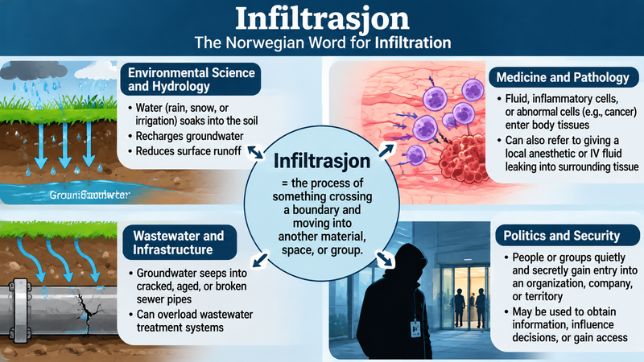
Infiltrasjon is the Norwegian word for infiltration. It describes the process through which something enters, passes through, or spreads into another material, space, system, or group. The term is used in several fields, including environmental science, hydrology, medicine, wastewater management, politics, and security. Although its meaning changes depending on the subject, the central idea remains the same: something crosses a boundary and moves into an area where it was not previously present.
Understanding Infiltrasjon is important because the process can have both beneficial and harmful effects. In environmental science, water infiltration helps replenish groundwater and maintain healthy ecosystems. In medicine, tissue infiltration can describe the movement of fluids, inflammatory cells, or abnormal cells into body tissues. In infrastructure, infiltration may cause groundwater to enter damaged sewer systems, while in politics and security, it can refer to the secret entry of individuals or groups into an organization.
This article explores the meaning, different types, causes, applications, and importance of Infiltrasjon across various disciplines.
What Does Infiltrasjon Mean?
Infiltrasjon refers to the movement of a substance, fluid, person, or group across a boundary and into another environment. The term is closely related to the English word infiltration and is commonly used to describe physical, biological, or organizational processes.
The exact meaning depends on the context in which the word appears. For example, when discussing soil and water, Infiltrasjon describes how water enters the ground. In medical terminology, it may describe substances or cells entering body tissues. In security discussions, it refers to gaining access to a restricted organization or location without being noticed.
Despite these different applications, all forms of infiltration involve movement from one area into another.
1. Infiltrasjon in Environmental Science and Hydrology
One of the most important uses of the term Infiltrasjon is in environmental science and hydrology. In this context, it refers to the process by which water enters the soil from the land surface.
Rainwater, melting snow, and irrigation water can infiltrate the ground and move through different soil layers. Some of this water is absorbed by plant roots, while some continues moving downward and eventually contributes to groundwater supplies.
How Water Infiltration Works
Water infiltration begins when water reaches the soil surface. The soil absorbs water through its pores, cracks, and spaces between particles. Gravity and soil-water pressure help move the water downward.
The process generally involves several stages:
- Water reaches the ground through rainfall, snowmelt, or irrigation.
- The upper soil layer absorbs the available water.
- Water moves through connected pores and spaces within the soil.
- Some water is stored in the soil and becomes available to plants.
- Additional water may travel deeper and recharge underground aquifers.
The speed of this process depends on soil characteristics, moisture levels, vegetation, and environmental conditions.
Factors That Affect Infiltration Rates
Several natural and human-related factors influence how quickly water enters the soil.
Soil Type: Sandy soils generally allow water to pass through quickly because they contain relatively large particles and connected spaces. Clay soils usually have smaller pores and can slow water movement.
Vegetation: Grass, trees, and other plants help maintain soil structure and create pathways for water. Their roots can improve soil porosity and encourage infiltration.
Organic Matter: Leaves, decomposed plants, and other organic materials improve soil structure and water retention. Organic matter can also reduce surface sealing.
Soil Compaction: Heavy machinery, construction, and excessive foot traffic can compress soil particles. This reduces pore space and makes it more difficult for water to enter the ground.
Slope: Water tends to run off more quickly on steep slopes, leaving less time for infiltration. Flatter surfaces often provide more opportunities for water to enter the soil.
Environmental Importance of Water Infiltration
Water infiltration plays a major role in maintaining the natural water cycle. It helps recharge groundwater aquifers, supports vegetation, and reduces the amount of water flowing over the land surface.
Healthy infiltration rates can also reduce soil erosion and help limit certain types of flooding. When water enters the ground rather than flowing directly into rivers and drainage systems, it can contribute to more balanced water distribution.
2. Infiltrasjon in Medicine and Pathology
In medicine, Infiltrasjon describes the movement or accumulation of substances, cells, or fluids within body tissues and organs. It is an important concept in pathology, clinical diagnosis, and medical procedures.
Depending on the situation, infiltration may be associated with normal medical treatment, inflammation, infection, or disease.
Tissue Infiltration
Tissue infiltration occurs when substances or cells enter the spaces between cells or spread through an organ’s tissues.
For example, inflammatory cells may move into affected tissue as part of the body’s immune response. This can happen during infections, injuries, and certain inflammatory conditions.
Abnormal cells, including cancer cells, may also infiltrate surrounding tissues. In such cases, infiltration can indicate that a disease is spreading beyond its original location.
Local Anesthetic Infiltration
Infiltration is also used in medical procedures involving local anesthesia. Healthcare professionals may inject a local anesthetic into the tissues around a specific area to temporarily block nerve signals and reduce pain.
This technique is commonly used during minor surgical procedures, dental treatments, and wound repairs.
The purpose is to numb a targeted area while allowing the patient to remain conscious.
Intravenous Infiltration
Another medical meaning involves intravenous (IV) therapy. IV infiltration occurs when fluid intended to enter a vein leaks into the surrounding tissue.
This may happen if the IV catheter moves out of the vein or is not properly positioned.
Possible signs include:
- Swelling around the IV insertion site.
- Pain or discomfort.
- Coolness of the surrounding skin.
- Tightness or changes in skin appearance.
- Slower or interrupted fluid administration.
Healthcare professionals monitor IV sites to identify complications early and provide appropriate treatment.
3. Infiltrasjon in Wastewater and Infrastructure
In wastewater management, Infiltrasjon commonly refers to groundwater entering sewer pipes and wastewater collection systems through damaged or poorly sealed sections.
Older sewer networks may develop cracks, loose joints, corrosion, and structural weaknesses. When groundwater levels are high, surrounding water can enter these damaged areas and mix with wastewater.
Common Causes of Sewer Infiltration
Several infrastructure problems can contribute to groundwater infiltration:
Cracked Pipes: Aging or damaged sewer pipes can develop openings that allow groundwater to enter.
Faulty Pipe Connections: Poorly sealed joints and connections may create pathways for unwanted water.
Corrosion: Chemical reactions and environmental conditions can weaken pipe materials over time.
Ground Movement: Soil settlement, construction activities, and changes in ground conditions can damage underground infrastructure.
Poor Maintenance: Delayed inspections and repairs can allow small problems to become major infrastructure issues.
Effects on Wastewater Treatment Systems
Groundwater infiltration can create significant challenges for wastewater management.
When excess groundwater enters sewer systems, the total volume of water transported to treatment facilities increases. This additional flow can place pressure on pumps, pipelines, and treatment equipment.
Potential consequences include:
- Increased operating and energy costs.
- Reduced treatment efficiency during high-flow periods.
- Greater pressure on sewer infrastructure.
- Increased risk of sewer overflows.
- Additional maintenance and repair requirements.
Prevention and Management
Municipal authorities and infrastructure operators can reduce infiltration through regular inspections, pipe rehabilitation, improved joint sealing, and replacement of severely damaged pipelines.
Technologies such as CCTV pipe inspections and leak detection systems can help identify problem areas before they cause extensive damage.
4. Infiltrasjon in Politics and Security
In politics, intelligence, and security, Infiltrasjon describes the process of secretly entering an organization, institution, company, or territory to gain access to information, influence decisions, or achieve a particular objective.
Unlike environmental or medical infiltration, this form involves people, groups, or agents rather than physical substances.
How Organizational Infiltration Happens
Infiltration can involve individuals gradually gaining access to an organization by presenting themselves as ordinary members, employees, contractors, or supporters.
In some cases, the purpose is to gather confidential information. In other situations, individuals may attempt to influence internal decisions, disrupt activities, or monitor an organization’s operations.
Common Areas of Security Infiltration
Corporate Security: Unauthorized individuals may attempt to enter companies to obtain confidential business information, trade secrets, or sensitive documents.
Political Organizations: Individuals may secretly join political groups to monitor activities or influence internal discussions.
Intelligence Operations: Intelligence agencies may use infiltration as a method of collecting information about foreign organizations or security threats.
Cybersecurity: The term can also describe unauthorized access to computer networks and digital systems, although cybersecurity professionals often use more specific terms such as intrusion or network compromise.
Why Security Infiltration Matters
Infiltration can create serious security and privacy risks. Organizations may lose confidential information, experience operational disruption, or face reputational damage.
To reduce these risks, organizations use background checks, access controls, identity verification, cybersecurity monitoring, and internal security policies.
5. Difference Between Beneficial and Harmful Infiltration
Infiltration is not always harmful. Its effects depend on what enters a particular environment and how the process takes place.
For example, water infiltration is generally beneficial because it helps replenish groundwater and supports plant growth. However, groundwater entering damaged sewer pipes can create operational problems.
Similarly, medical infiltration may be intentional and useful when administering local anesthesia, but the spread of abnormal cells into surrounding tissues can be a serious health concern.
In security, authorized investigations may involve controlled access to an organization, while unauthorized infiltration can threaten safety, privacy, and institutional stability.
Therefore, understanding the context is essential when interpreting the term Infiltrasjon.
6. Why Is Understanding Infiltrasjon Important?
Understanding Infiltrasjon helps professionals recognize how substances, fluids, cells, or individuals move across boundaries.
Its importance can be explained through several practical applications:
Environmental Protection: Understanding soil infiltration helps scientists and land managers improve water conservation, reduce runoff, and protect groundwater resources.
Medical Diagnosis: Recognizing tissue infiltration can help healthcare professionals assess inflammation, infections, and certain diseases.
Infrastructure Management: Identifying groundwater infiltration allows engineers to maintain sewer networks and improve wastewater treatment efficiency.
Security Planning: Understanding organizational infiltration helps companies and institutions develop stronger security policies and protect sensitive information.
The concept is also useful in education and research because it connects different scientific and professional disciplines through a common process.
7. Challenges Associated With Infiltration
Although infiltration can provide important benefits, it may also create challenges depending on the environment.
In hydrology, excessive surface water infiltration can sometimes contribute to soil saturation and groundwater contamination when pollutants are present. In medicine, certain types of tissue infiltration may indicate serious underlying conditions. In wastewater systems, unwanted groundwater infiltration can increase operating costs and reduce system capacity.
In security, infiltration can be difficult to detect because individuals may attempt to conceal their identities or intentions.
These challenges demonstrate why monitoring, research, prevention, and appropriate management are important in every field where infiltration occurs.
FAQs) Infiltrasjon
1. What does Infiltrasjon mean in English?
Infiltrasjon is the Norwegian word for infiltration. It describes the process of something entering or spreading into another material, space, tissue, system, or organization.
2. What is Infiltrasjon in environmental science?
In environmental science, Infiltrasjon refers to the process by which water enters the soil from the ground surface. It helps replenish groundwater and supports plant growth.
3. What factors affect water infiltration?
Important factors include soil type, vegetation, organic matter, soil compaction, slope, and existing soil moisture. Sandy soils generally allow faster infiltration than heavily compacted or clay-rich soils.
4. What does infiltration mean in medicine?
In medicine, infiltration can describe the movement of fluids, inflammatory cells, or abnormal cells into body tissues. It can also refer to the administration of local anesthetic or unintended IV fluid leakage into surrounding tissue.
5. What is groundwater infiltration in sewer systems?
It occurs when groundwater enters sewer pipes through cracks, damaged joints, or other structural openings. This increases the amount of water flowing through wastewater collection and treatment systems.
6. What is infiltration in politics and security?
In politics and security, infiltration refers to secretly entering an organization, company, or territory to collect information, influence activities, or achieve a particular objective.
7. Is infiltration always harmful?
No. Infiltration can be beneficial or harmful depending on the situation. Water entering healthy soil is beneficial, while unwanted groundwater entering sewer pipes or abnormal cells spreading through tissues can cause problems.
8. Why is Infiltrasjon important?
Infiltrasjon is important because it influences groundwater recharge, medical conditions, wastewater infrastructure, and organizational security. Understanding the process helps professionals manage its benefits and reduce potential risks.
Conclusion
Infiltrasjon is a versatile term that describes the movement of something across a boundary and into another environment. Although it originates as a Norwegian word for infiltration, its applications extend across environmental science, hydrology, medicine, pathology, wastewater management, politics, and security.
In nature, water infiltration supports groundwater recharge and healthy ecosystems. In medicine, infiltration can describe both useful procedures and potentially serious tissue conditions. In infrastructure, it highlights the importance of maintaining sewer systems, while in security, it emphasizes the need to protect organizations from unauthorized access.
Ultimately, understanding Infiltrasjon provides valuable insight into how different systems interact, how substances and individuals move between environments, and why proper monitoring and management are essential.