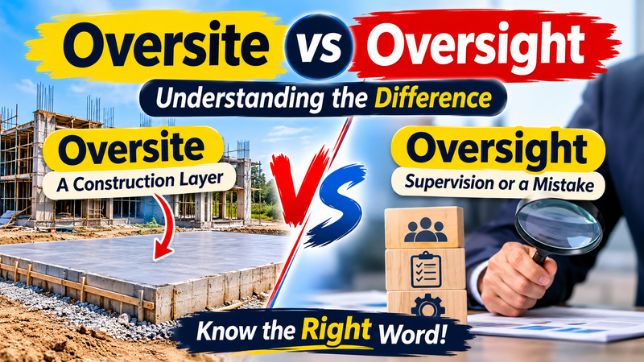
English contains many words that look or sound similar but have completely different meanings or levels of correctness. One common example is Oversite vs Oversight. These two terms can easily confuse writers, students, professionals, and people learning English. Although they differ by only one letter, their usage and meanings are not the same.
The word “oversight” is the standard English term commonly used to describe supervision, monitoring, or an unintentional mistake. On the other hand, “oversite” is a much less common word that has specialized meanings, particularly in construction. Understanding the difference between these terms can help improve writing accuracy, professional communication, and everyday English.
What Does Oversight Mean?
“Oversight” is a standard English noun with two main meanings. First, it refers to the process of supervising, monitoring, or managing an activity to ensure that everything is completed correctly. Second, it describes an accidental mistake or something that has been unintentionally forgotten or overlooked.
In professional environments, oversight often refers to the responsibility of monitoring employees, projects, financial activities, or organizational operations. For example, a manager may provide oversight to ensure that a team follows company policies and completes its responsibilities.
The word can also describe an unintended error. For instance, if someone forgets to include an important document in an email, they might explain that the omission was an oversight.
Examples of Oversight: Oversite vs Oversight
- The project requires careful oversight from experienced managers.
- The company introduced new procedures to improve financial oversight.
- Leaving his name off the invitation was an unfortunate oversight.
- Government oversight helps ensure that public institutions follow regulations.
These examples demonstrate how the same word can describe both supervision and an accidental mistake, depending on the context.
What Does Oversite Mean?
“Oversite” is a real but uncommon English word. It is primarily associated with construction and building terminology rather than everyday communication.
In construction, an oversite generally refers to a layer of concrete or another suitable material laid over prepared ground, often beneath a floor. It provides a base for the construction of a ground-floor structure.
The term is sometimes used in expressions such as “oversite concrete” or “oversite layer.” Its exact application can vary depending on construction practices and regional terminology.
Examples of Oversite: Oversite vs Oversight
- The builders prepared the ground before installing the oversite concrete.
- The construction team completed the oversite layer before proceeding with the flooring.
- Proper preparation is essential before pouring concrete over the oversite area.
Unlike oversight, oversite is not generally used to describe management, supervision, or an accidental mistake.
Oversite vs Oversight Key Differences
Although these words look almost identical, their meanings and applications are different. Understanding their distinctions makes it easier to choose the correct word when writing or speaking.
| Comparison | Oversite | Oversight |
| Word type | Noun | Noun |
| Common usage | Specialized construction terminology | Everyday and professional English |
| Main meaning | A construction layer over prepared ground | Supervision or an accidental mistake |
| Professional context | Building and construction | Business, management, government, and administration |
| General popularity | Uncommon | Very common |
| Example | Oversite concrete | Management oversight |
The most important distinction is that oversight relates to supervision or an unintended error, while oversite is associated with a specific construction application.
When Should You Use Oversight?
You should use “oversight” whenever you are discussing supervision, responsibility, monitoring, or an unintentional omission.
In business communication, it is commonly used to describe how managers supervise employees, how organizations monitor performance, and how authorities ensure compliance with established standards.
For example, a company might establish a financial oversight department to monitor spending and prevent financial irregularities.
The word is also useful when acknowledging mistakes professionally. Instead of blaming someone for a forgotten task, a person might say, “It was an oversight on my part.”
This expression communicates that the mistake was unintentional and helps maintain a professional tone.
When Should You Use Oversite?
The word “oversite” should generally be reserved for specialized construction discussions. It is appropriate when describing the preparation of a ground-floor base or the concrete layer used in certain building projects.
For example, architects, builders, engineers, and construction workers may use the term when discussing floor foundations and ground preparation.
However, using “oversite” in general business communication or when referring to supervision would be incorrect. In those situations, “oversight” is the appropriate choice.
Common Mistakes When Using Oversite and Oversight
One of the most common mistakes is using “oversite” when the intended meaning is supervision or monitoring. Because the two words look similar, writers sometimes confuse their spelling.
Another mistake is using “oversight” without considering its two different meanings. Depending on the sentence, it can refer to either responsible supervision or an accidental error.
Consider these examples: Oversite vs Oversight
Incorrect: The manager provides oversite of the employees.
Correct: The manager provides oversight of the employees.
Incorrect: Forgetting the appointment was an oversite.
Correct: Forgetting the appointment was an oversight.
Correct construction usage: The workers installed the oversite concrete before completing the floor.
Reviewing the context before selecting a word is the easiest way to avoid these errors.
Why Is Understanding the Difference Important?
Understanding the difference between similar words is important for effective communication. Even a small spelling mistake can change the meaning of a sentence or make professional writing appear less accurate.
For students, learning the distinction improves vocabulary and English grammar skills. For business professionals, it helps ensure that reports, emails, presentations, and official documents communicate the intended message.
In construction-related writing, using the correct technical terminology also helps prevent confusion between building materials, processes, and management responsibilities.
Writers should therefore pay attention to the meaning of each word rather than relying only on how it looks or sounds.
Tips to Remember the Difference
A simple way to remember these terms is to connect each word with its main purpose.
- Oversight = Supervision: Think about managers overseeing employees or projects.
- Oversight = Mistake: Remember that an oversight can be something accidentally forgotten.
- Oversite = Construction: Associate this spelling with oversite concrete and building foundations.
Another useful approach is to read the complete sentence before choosing a word. If the sentence discusses monitoring, responsibility, or an accidental error, “oversight” is almost certainly the correct choice. If it discusses a construction layer beneath a floor, “oversite” may be appropriate.
FAQs) Oversite vs Oversight
1. What is the main difference between oversite and oversight?
Oversight is a common English word meaning supervision or an unintentional mistake. Oversite is a less common technical term associated with construction, particularly a layer of material placed over prepared ground.
2. Is oversite a real English word?
Yes. Oversite is a recognized but uncommon word, mainly used in construction terminology. It is not simply another spelling of oversight.
3. Is oversight one word or two?
Oversight is written as one word. It should not be separated into two words.
4. Can oversight mean a mistake?
Yes. Oversight can describe an accidental error, omission, or something that someone unintentionally forgot to do.
5. What is oversite concrete?
Oversite concrete is a concrete layer laid over prepared ground, commonly as part of the preparation for a ground-floor structure.
6. Which word should I use in professional writing?
In most professional situations involving supervision, monitoring, or accidental errors, use “oversight.” Use “oversite” only when discussing its specific construction-related meaning.
7. Is oversite a spelling mistake for oversight?
Not necessarily. Oversite is a legitimate specialized term. However, it is often an incorrect spelling when someone intends to write “oversight.”
Conclusion Oversite vs Oversight
The difference between Oversite vs Oversight is small in spelling but significant in meaning. Oversight is the widely used English word that describes supervision, monitoring, or an unintentional mistake. Oversite, in contrast, is a specialized construction term referring to a layer placed over prepared ground.
Choosing the correct word depends entirely on the context. Whether you are writing a business report, preparing an academic assignment, or discussing a construction project, understanding these distinctions will help you communicate more clearly and accurately. Remember that oversight is the right choice for everyday and professional discussions about supervision or mistakes, while oversite belongs mainly to construction-related terminology.
Oversite vs Oversight Oversite vs Oversight Oversite vs Oversight Oversite vs Oversight Oversite vs Oversight Oversite vs Oversight Oversite vs Oversight Oversite vs Oversight Oversite vs Oversight Oversite vs Oversight Oversite vs Oversight Oversite vs Oversight Oversite vs Oversight Oversite vs Oversight Oversite vs Oversight Oversite vs Oversight Oversite vs Oversight