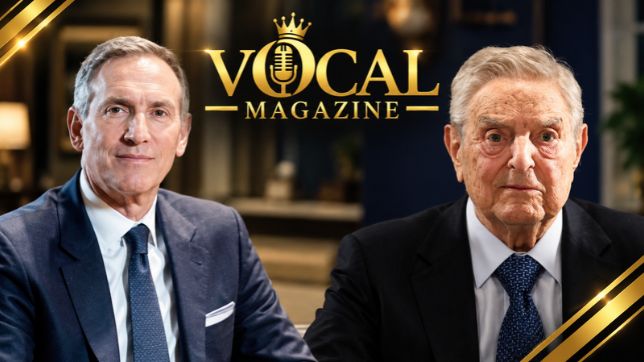
Howard Schultz and George Soros are two prominent American billionaire figures whose careers have influenced business, philanthropy, and political discussions in the United States. Although they built their fortunes in different industries, both have become recognizable names in debates about wealth, leadership, corporate responsibility, and political influence. Schultz is best known for transforming Starbucks into a globally recognized coffeehouse brand, while Soros is known for his achievements in investment management and his extensive philanthropic activities through the Open Society Foundations.
Their paths have intersected indirectly through American political discussions, particularly during the debate surrounding Schultz’s potential independent presidential campaign in 2020. His possible candidacy attracted criticism from Democrats who worried that an independent candidate could divide voters opposing Donald Trump. Political organizations connected to Democratic causes, including American Bridge 21st Century, participated in efforts to scrutinize Schultz’s record. Soros, meanwhile, became part of the wider public conversation about wealthy donors and their influence on political organizations.
Understanding Howard Schultz and George Soros requires examining their backgrounds, professional achievements, political interests, and roles in discussions about the relationship between money and democracy.
Who Is Howard Schultz?
Howard Schultz is an American businessman best known for his leadership at Starbucks, one of the world’s most recognizable coffeehouse companies. Born on July 19, 1953, in Brooklyn, New York, Schultz grew up in a working-class family. His early experiences shaped his views about economic opportunity, employment, and the importance of providing workers with benefits.
Schultz attended Northern Michigan University, where he earned a degree in communications. Before joining Starbucks, he worked in sales and marketing, including a position with a Swedish housewares company. During a business visit to Starbucks in Seattle, he became interested in the company’s approach to selling coffee beans and saw an opportunity to develop a broader coffeehouse experience.
In 1982, Schultz joined Starbucks as director of retail operations and marketing. After visiting Italy, he became inspired by the country’s traditional coffee bars, where customers gathered to enjoy espresso and socialize. He believed a similar concept could succeed in the United States.
Schultz eventually established his own coffeehouse business, Il Giornale, before acquiring Starbucks in 1987. Under his leadership, Starbucks expanded across the United States and internationally, developing a brand associated with specialty coffee, customer service, and comfortable social spaces.
Howard Schultz’s Business Achievements
Schultz played a central role in transforming Starbucks from a relatively small coffee retailer into a global company. His strategy emphasized consistent products, recognizable stores, employee development, and a customer experience that extended beyond simply purchasing coffee.
Starbucks expanded its menu, introduced new beverages, and opened locations in numerous international markets. Its growth helped popularize specialty coffee culture in countries where traditional coffee consumption had often centered on home preparation or smaller independent cafes.
Another important part of Schultz’s leadership involved employee benefits. Starbucks became known for offering certain eligible employees healthcare benefits and opportunities to participate in company equity programs. Supporters viewed these policies as evidence that businesses could combine commercial success with investment in their workforce.
However, Starbucks also faced criticism over labor relations, store working conditions, and unionization efforts. These controversies illustrate the challenges of balancing corporate growth, employee expectations, and shareholder interests.
Schultz stepped down as chief executive in 2000, returned to the position in 2008, and later resumed leadership during another transition period. His career remains closely associated with Starbucks’ development and the broader evolution of the modern coffee industry.
Who Is George Soros?
George Soros is a Hungarian-born American investor, philanthropist, and author. Born György Schwartz on August 12, 1930, in Budapest, Hungary, he experienced the dangers of antisemitism and Nazi occupation during World War II. His family survived by taking measures to conceal their Jewish identity and navigate a period of extreme persecution.
After the war, Soros moved to England, where he studied at the London School of Economics. The philosopher Karl Popper’s ideas, particularly those concerning open societies and the dangers of authoritarianism, influenced his intellectual outlook.
Soros later moved to the United States and entered the financial industry. He established Soros Fund Management and became widely known as a successful hedge fund manager. His investment activities generated substantial wealth and helped make him one of the most prominent figures in international finance.
Soros is also known for his financial market speculation, particularly a highly publicized 1992 currency trade involving the British pound. His success during the United Kingdom’s withdrawal from the European Exchange Rate Mechanism earned him widespread attention in financial news and contributed to his reputation as an influential investor.
Beyond finance, Soros became one of the world’s best-known philanthropists, supporting educational initiatives, civil society organizations, human rights programs, and democratic institutions.
George Soros and the Open Society Foundations
One of Soros’s most significant contributions outside finance is his support for the Open Society Foundations. The philanthropic network funds organizations and initiatives concerned with human rights, accountable government, education, public health, and access to justice.
Soros began supporting educational and civil society projects in the 1970s. His philanthropic work later expanded across numerous countries, including efforts to support independent institutions and democratic participation in societies undergoing political and economic change.
The Open Society Foundations have provided funding to nonprofit organizations, journalists, educational institutions, and advocacy groups. Supporters argue that such funding helps marginalized communities, strengthens public accountability, and protects civil liberties.
Critics, however, question the influence that a wealthy individual can exercise through large-scale philanthropy. Some governments and political movements have accused Soros-backed organizations of promoting agendas that conflict with national interests or existing political priorities.
These disagreements have made Soros a controversial figure in international politics. His supporters often describe him as a defender of democratic values, while his critics argue that private wealth should not give individuals disproportionate influence over public affairs.
Howard Schultz and the 2020 Presidential Debate
Howard Schultz attracted national political attention in 2019 when he explored the possibility of running for president of the United States as an independent candidate in the 2020 election.
Schultz presented himself as a political centrist who was dissatisfied with the two-party system. He criticized aspects of both major parties and suggested that an independent candidate could offer voters an alternative to established political leadership.
His potential campaign immediately generated controversy. Many Democrats feared that Schultz could attract moderate voters who otherwise would support the Democratic nominee. Because the presidential election was expected to be highly competitive, opponents argued that an independent campaign could unintentionally help Donald Trump win reelection by splitting the opposition vote.
Political organizations and Democratic-aligned groups scrutinized Schultz’s business record, public statements, and policy positions. American Bridge 21st Century, a political research organization associated with Democratic causes, was among the groups involved in examining his potential candidacy.
The controversy demonstrated how presidential campaigns can generate opposition even before a candidate formally enters the race. It also highlighted the difficulties faced by wealthy individuals who seek to challenge established political parties.
Schultz ultimately did not run for president in 2020. Nevertheless, the speculation surrounding his possible candidacy became an important example of the debate over independent candidates and electoral strategy.
How Howard Schultz and George Soros Are Connected
The relationship between Howard Schultz and George Soros is primarily understood through the broader political environment surrounding wealthy individuals, campaign organizations, and the 2020 presidential election.
Their public profiles place them in different parts of the American political landscape. Schultz explored an independent presidential campaign, while Soros became known for supporting progressive causes, Democratic-aligned political activity, and organizations advocating liberal democratic principles.
American Bridge 21st Century attracted attention during the controversy surrounding Schultz’s potential candidacy. Soros has been associated with financial support for Democratic political causes, but that broader association does not establish that he personally directed opposition to Schultz or commissioned a particular research campaign against him.
It is therefore important to distinguish between a direct personal relationship and an indirect political connection. Public discussions sometimes group wealthy business leaders and political donors together because of their financial resources and public influence. However, shared involvement in political debates does not necessarily mean that two individuals worked together or had a personal dispute.
The connection between Schultz and Soros is best understood as part of the larger discussion about how billionaires, political organizations, and campaign financing interact in American democracy.
Billionaires and Political Influence in America
The experiences of Schultz and Soros illustrate different ways wealthy individuals can participate in public life. Schultz built a business empire and considered seeking elected office, while Soros used his financial success to support philanthropic and political causes.
American political campaigns require substantial resources for advertising, staffing, research, travel, and voter outreach. Wealthy individuals can influence these activities through campaign contributions, political action committees, independent expenditures, and support for advocacy organizations, subject to applicable laws.
Philanthropy also affects public policy discussions by providing resources to organizations working on education, civil rights, environmental issues, and democratic reform. Such funding can help organizations pursue important public-interest goals, but it can also raise questions about accountability and the concentration of private power.
Schultz’s potential presidential campaign illustrated how personal wealth can provide an individual with the resources to explore a national political campaign outside traditional party structures. Soros’s philanthropic and political activities demonstrate how financial resources can support causes and institutions over many years.
Both examples encourage public discussion about transparency, campaign finance rules, and the balance between private initiative and democratic accountability.
Public Perception and Controversy
Howard Schultz and George Soros have received both praise and criticism, although the reasons differ.
Schultz is frequently praised for building Starbucks into a global brand and helping make specialty coffee more widely accessible. His emphasis on employee benefits has also received positive attention. On the other hand, critics have questioned his political judgment, corporate labor policies, and decision to consider an independent presidential campaign.
Soros is admired by supporters for funding educational opportunities, human rights programs, and democratic institutions. Critics question his political donations and the influence of organizations supported by his philanthropy.
Public debate about both figures sometimes becomes polarized, especially when discussions involve political ideology, corporate power, or the role of billionaires in elections. Responsible analysis requires distinguishing documented financial support and public statements from unverified claims about secret coordination or personal motives.
Examining their records in context allows readers to evaluate their influence without relying solely on partisan narratives.
Conclusion
Howard Schultz and George Soros represent two different paths to wealth and public influence in modern America. Schultz became a leading business figure through his transformation of Starbucks and later attracted political attention by considering an independent run for president in 2020. Soros achieved prominence through investment management and developed an extensive philanthropic network supporting open societies, civil liberties, and democratic institutions.
Their indirect intersection in political discussions surrounding Schultz’s potential candidacy highlights the complicated relationship between money, elections, and political organizations. Although both men have faced scrutiny because of their wealth and public activities, their professional goals and methods of influence are distinct.
Ultimately, the stories of Schultz and Soros raise important questions about the responsibilities of wealthy individuals in democratic societies. Their experiences demonstrate that financial success can create opportunities to shape business, philanthropy, and public debate. At the same time, they reinforce the importance of transparency, factual reporting, and accountability whenever private wealth intersects with public power.
Howard Schultz and George Soros Howard Schultz and George Soros Howard Schultz and George Soros Howard Schultz and George Soros Howard Schultz and George Soros Howard Schultz and George Soros Howard Schultz and George Soros Howard Schultz and George Soros Howard Schultz and George Soros Howard Schultz and George Soros Howard Schultz and George Soros Howard Schultz and George Soros
Frequently Asked Questions
Who are Howard Schultz and George Soros?
Howard Schultz is the former longtime CEO of Starbucks, while George Soros is an investor and philanthropist known for founding Soros Fund Management and supporting the Open Society Foundations.
Are Howard Schultz and George Soros directly connected?
Their names intersect primarily in broader discussions of American politics and the influence of wealthy individuals. Their political profiles do not, by themselves, establish a direct personal relationship.
Why did Howard Schultz consider running for president in 2020?
Schultz explored an independent presidential campaign in 2019, presenting himself as a centrist alternative to the two major political parties. He ultimately did not run.
What is George Soros known for?
Soros is known for his investment career, a prominent 1992 currency trade involving the British pound, and extensive philanthropic support for civil society and democratic institutions.
What is the Open Society Foundations?
The Open Society Foundations is a philanthropic network that supports initiatives involving human rights, education, justice, accountable government, and democratic participation.
Why are Schultz and Soros discussed in debates about billionaires and politics?
Both have attracted attention because of their wealth and public activities. Schultz considered a presidential campaign, while Soros has funded philanthropic and political causes, raising broader questions about money and democratic influence.
Howard Schultz and George Soros Howard Schultz and George Soros Howard Schultz and George Soros Howard Schultz and George Soros Howard Schultz and George Soros