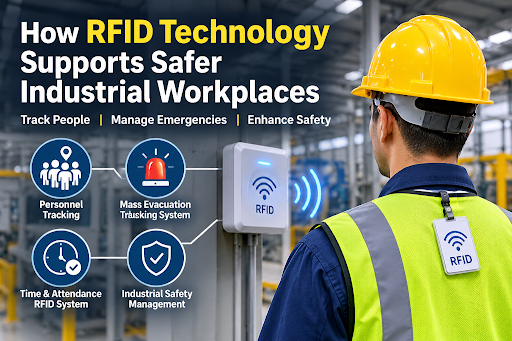
Industrial workplaces require effective safety management, accurate personnel identification, and reliable emergency response procedures. Manufacturing plants, warehouses, processing facilities, and other industrial environments often involve heavy machinery, restricted areas, hazardous materials, and constantly changing working conditions. In these settings, knowing who is inside a facility, where employees are working, and whether everyone has reached a designated safe area during an emergency is essential.
Traditional safety procedures often depend on manual attendance records, access cards, paper-based registers, and verbal communication. Although these methods can support basic operations, they may not provide the real-time visibility needed in complex industrial environments. RFID technology offers a more automated approach by helping organisations identify personnel, monitor movement, manage access, and improve emergency preparedness.
By integrating RFID-based identification and tracking solutions into industrial safety management, organisations can strengthen workplace visibility, improve operational coordination, and support more reliable personnel accountability.
Understanding RFID Technology in Industrial Environments
Radio Frequency Identification (RFID) is a wireless identification technology that uses radio waves to communicate between electronic tags and RFID readers. These systems allow organisations to identify tagged employees, equipment, vehicles, and other assets without requiring direct physical contact or manual scanning in every situation.
An RFID system generally consists of three main components:
- RFID tags: Small electronic devices attached to employee identification badges, equipment, or other objects.
- RFID readers: Devices that detect and collect information from RFID tags within their reading range.
- Software platforms: Systems that process collected information and present relevant data through centralised dashboards and reports.
Depending on the application, organisations can use passive or active RFID tags. Passive tags receive energy from the reader’s radio signal, while active RFID tags use an internal battery to transmit signals and support applications requiring longer detection ranges.
In industrial environments, RFID technology can connect identification, access management, personnel tracking, and safety monitoring into a coordinated system. This makes it easier for safety managers to maintain accurate operational records and respond to changing workplace conditions.
How RFID Personnel Tracking Improves Workplace Safety
Knowing where employees are working is an important part of industrial safety management. Large manufacturing facilities, distribution centres, mines, and industrial plants may contain multiple departments, restricted zones, and hazardous operating areas. Without an organised identification system, monitoring personnel movement across these locations can become difficult.
RFID personnel tracking helps organizations improve visibility by automatically detecting employee identification tags through strategically installed readers. Depending on the system design, these readers can detect when personnel enter or leave designated areas and report their presence within monitored zones.
This capability supports several important workplace safety activities:
- Restricted-area monitoring: Organisations can identify personnel entering controlled or hazardous areas.
- Personnel identification: RFID badges help distinguish authorised employees from visitors and contractors.
- Movement visibility: Safety teams can see who is present in designated operational zones.
- Access management: RFID-based credentials can support entry permissions for specific departments and facilities.
- Operational coordination: Managers can use tracking information to improve workforce organisation and safety procedures.
Real-time personnel tracking can be particularly useful in environments where employees work across different locations or perform tasks in areas with specific safety requirements. However, RFID detection should complement established safety procedures rather than replace direct supervision and hazard assessments.
The Role of RFID Technology in Emergency Evacuation Management
Emergencies such as fires, chemical leaks, equipment failures, and structural incidents require immediate action. Industrial facilities must have clear evacuation procedures to ensure employees, contractors, and visitors can reach designated assembly points safely.
However, traditional evacuation procedures can create challenges when organizations need to account for large numbers of people. Manual headcounts, attendance sheets, and verbal confirmation may delay the identification of missing personnel, particularly when employees work across multiple buildings or restricted areas.
A mass evacuation tracking system powered by RFID technology can help address these challenges by automatically identifying personnel as they enter or leave designated areas.
Employees carry RFID-enabled identification badges that communicate with strategically positioned readers. During an evacuation, the system can collect identification data and generate reports showing which individuals have reached designated muster points and which remain unaccounted for.
Key capabilities include:
- Automated headcounts: Identify employees without requiring manual badge scanning.
- Real-time muster reports: Provide updated information about personnel who have reached assembly points.
- Missing-person identification: Help emergency response teams identify individuals who have not been accounted for.
- Visitor accountability: Include contractors, temporary workers, and visitors in evacuation procedures.
- Movement monitoring: Support entry and exit detection across designated facility locations.
For facilities with large entrances or high employee movement, simultaneous RFID identification can make evacuation monitoring more efficient.
For example, IDENTEC provides industrial RFID solutions designed for automatic personnel identification, safety registration, and emergency evacuation monitoring. Its technology supports hands-free identification and real-time personnel accountability. Businesses interested in exploring these applications can learn more about RFID technology and industrial identification solutions.
Importantly, RFID evacuation systems should support established emergency response procedures, including physical inspections, communication protocols, and trained emergency personnel.
How Time and Attendance RFID Systems Support Employee Management
Accurate employee attendance records contribute to both workforce management and workplace safety. Industrial managers need reliable information about who has entered a facility, which employees are working specific shifts, and whether contractors or visitors are present.
A time and attendance RFID system automates employee identification and attendance recording through RFID-enabled badges and readers.
Instead of relying entirely on manual registers or traditional clock-in procedures, organisations can use RFID readers to detect employee credentials at designated entry points. The collected information can then be processed through attendance management software.
This approach offers several operational advantages:
- Automated attendance recording
RFID readers can automatically register employee entry and exit events, reducing repetitive administrative tasks.
- Improved personnel records
Centralised attendance information helps managers maintain organised records of workforce presence and shift schedules.
- Better workforce coordination
Supervisors can use attendance information to understand staffing levels across departments and operational areas.
- Integration with access control
RFID credentials can support employee identification and controlled access to authorised facility locations.
- Improved emergency accountability
Attendance information can provide additional context when safety teams verify which employees, contractors, and visitors should be accounted for during an emergency.
When integrated with personnel tracking and emergency management applications, RFID-based attendance systems become a valuable component of a wider industrial safety system.
Key Benefits of RFID Technology for Industrial Facilities
Implementing RFID technology can improve several aspects of industrial operations. Its value extends beyond employee identification because it can connect personnel monitoring, access management, attendance registration, and emergency preparedness.
1. Improved Personnel Visibility
RFID systems help organisations understand personnel presence across designated locations. This information supports better coordination between departments and helps safety managers identify potential accountability gaps.
2. Stronger Emergency Preparedness
Automated identification and evacuation reporting help organisations establish more organised emergency procedures. Safety teams can access personnel information more efficiently when responding to critical incidents.
3. Better Access Management
RFID-enabled credentials can help restrict entry to authorised personnel in sensitive areas. Organisations can establish different access permissions for employees, contractors, and visitors according to their responsibilities.
4. Reduced Manual Administration
Automated identification reduces dependence on repetitive manual processes. Attendance records, personnel registration, and movement information can be collected electronically, making routine administration more efficient.
5. Improved Industrial Safety Management
Combining personnel identification with location-based monitoring can help organisations improve awareness of workplace conditions. For example, RFID detection solutions can support safety applications around hazardous machinery by identifying when personnel enter designated danger zones.
6. Scalable Workplace Safety Technology
RFID infrastructure can be designed around the requirements of individual facilities. Organizations can introduce readers at entrances, assembly points, restricted zones, and other important locations before expanding the system to additional operational areas.
Important Considerations When Implementing an RFID Industrial Safety System
Selecting an appropriate RFID solution requires an understanding of the facility’s operational environment and safety requirements.
Before implementation, organisations should evaluate several factors:
- Facility size and layout: Determine the number of readers and detection points required.
- Tag technology: Select passive or active RFID tags according to identification range and application requirements.
- Reading accuracy: Evaluate how reliably the system identifies multiple personnel moving through busy entrances.
- Environmental conditions: Consider machinery, metal structures, temperature, and other potential sources of interference.
- Software integration: Ensure the solution can communicate with existing access control, attendance, and safety management platforms.
- Data protection: Establish appropriate controls for employee information, system access, and data retention.
- Emergency procedures: Test evacuation workflows regularly to ensure personnel can be accounted for correctly.
Organisations should also assess whether the selected equipment meets relevant safety and hazardous-area requirements. Where potentially explosive atmospheres exist, suitable certified equipment and professional safety assessments are essential.
Conclusion: Building Safer Industrial Workplaces with RFID Technology
Workplace safety requires accurate information, effective communication, and reliable emergency procedures. In complex industrial environments, traditional manual identification methods may not provide the visibility required to manage personnel efficiently.
RFID technology offers a practical way to strengthen industrial safety management through automated personnel identification, movement monitoring, attendance registration, and emergency evacuation support.
By implementing RFID personnel tracking, a mass evacuation tracking system, and a time and attendance RFID system, organisations can improve personnel accountability, support access management, and create more organised workplace safety procedures.
For industrial managers and safety professionals, integrating modern RFID solutions into existing safety infrastructure can support a more informed, responsive, and efficient working environment. Ultimately, the goal is not simply to track employees but to ensure that organisations have the information and systems needed to protect their people.