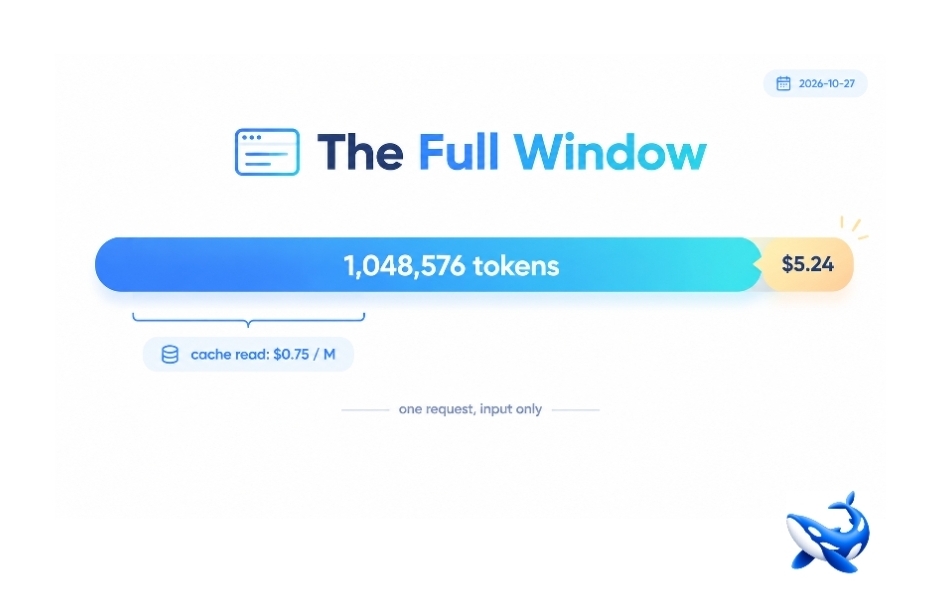
Through OrcaRouter the OrcaCyber Ultra 1M context is the product, and it has a price per fill: at $5.00 per million input tokens, loading the entire 1,048,576-token window costs $5.24 before the model writes a word [OURS]. That is not a reason to avoid it. It is the number that decides which jobs the card should be pointed at.
Most discussions of large context windows treat them as free capacity. They are not; they are the most expensive input in the family per token.
The arithmetic of a full window
| Line | Cost |
| 1,048,576 input at $5.00/M | $5.24 |
| 20,000 output at $10.00/M | $0.20 |
| One maximum-context request | $5.44 |
Compare the same request on the cheap tier at $0.80 input: $0.87, or on the middle tier at $3.00: $3.30 [OURS].
The gap is roughly six to one against the cheap tier. That ratio is the whole question: does filling the window buy six times the value?
When a full window earns its price
Three cases where it plainly does.
A vulnerability that spans files. The class of bug where the flaw is in the interaction between two components — a caller that violates a contract, a shared buffer with mismatched assumptions, an authentication check in the wrong layer. A model reading the whole tree sees both sides; a model reading one file sees one.
A long forensic timeline. Weeks of logs plus the code that produced them plus the configuration. The relationships are temporal and cross-referential, and a chunked read loses them.
An audit report plus the system it audits. The finding says what should be true; the code says what is. Only both together produce a verdict.
In each, the value is not “more tokens” but “relationships preserved”.
When it does not
Three cases where the window is wasted money.
Single-file questions. A stack trace, a function, a config. The model needs a few thousand tokens, and the rest is noise that dilutes attention.
Bulk classification. If the task is “label each of these fifty documents”, a million-token window is the wrong instrument; fifty small calls are cheaper and more accurate.
Retrieval-shaped problems. If you already have a search layer that finds the right three files, sending the whole repository is a more expensive way to reach the same place.
The honest test is whether the model needs to see across the evidence or only within it.
The cache changes the calculus
Inside a long session, the window is not paid for repeatedly. Cache reads price at $0.75 per million — fifteen percent of the input rate [OURS].
A million-token prefix sent five times: the first call writes and pays the input rate, the next four read at $0.75 each. Total input cost $5.24 + 4 × $0.75 = $8.24, or $1.65 per call [OURS].
That is a different product from the one-shot $5.24, and it is why the same repository reviewed across several questions is cheaper per question than a single review.
The reverse is also true: a one-off look at a million tokens pays the full price for a single answer, which is the worst value the card offers.
The comparison that matters
Against the cheap tier, a full-window request costs $5.44 against $0.87. Against the middle tier, $5.44 against $3.30.
The middle tier is the interesting one, because it also carries a million-token window — 1,000,000 rather than 1,048,576 — and a fourth benchmark row. The flagship’s premium over it is 1.67× on input.
So the real question is not “is a million-token window worth it” but “is this specific million-token window worth 1.67× the sibling’s”.
That is a much narrower question, and the answer depends entirely on whether the flagship’s depth produces findings the sibling misses. Which is measurable on your own cases, and on nothing else.
Budgeting by window fill
A simple planning rule: estimate the fill you actually use, not the maximum.
If your typical request is 200,000 tokens, the flagship costs $1.00 of input per call, not $5.24. The million-token ceiling is capacity, not a bill.
Write the typical fill into your cost model and treat the maximum as a tail risk. That is how every other capacity budget works, and it is the right frame here too — the ceiling is a limit, not a target.
What a full window does to retrieval design
If the whole corpus is in the prompt, do you still need a retrieval layer?
Three answers, depending on the question.
For a cross-cutting question — “where does this system handle authentication” — no. The model reads everything and answers, and a retrieval layer would have needed to know which files mattered, which is the thing you were trying to find out.
For a needle question — “what does line 412 of parser.c do” — yes, but not for the model. Retrieval is faster and cheaper for you to build than paying five dollars per million to ask a general question.
For repeated questions over a stable corpus — it depends on the cache. With the prefix cached at $0.75 per million, repeated full-window reads are affordable. Without cache hits, they are not.
The practical design is a router: full window when the question is structural, retrieval when it is locational, and the cache holding the corpus between the two.
A note on prefill
A million tokens takes time to read. The card’s 4,046 ms median first token is measured on whatever mix of inputs its users sent, and a full window sits at the slow end of that distribution.
For batch work, prefill is just latency. For anything with a user attached, it is the difference between a tool and a wait — which is another argument for the split described above.
The takeaway
A full window costs $5.24 of input at this card’s rate, and $5.44 for a maximum request. The number is not a warning; it is a scoping tool.
Use the window when the evidence has to be seen together. Use smaller calls when it does not. And when the same corpus is queried repeatedly, let the cache — fifteen percent of input — do the work.
The single sentence version: a full window costs five dollars and change, so make the window earn it.
A useful sanity check before committing a workload: divide the request cost by the number of findings you expect. If it lands above the cost of an analyst minute per finding, the economics need re-examining — not because the card is expensive, but because the scope is probably too broad.
Sourcing note: prices, cache rate, context window and output ceiling are OrcaRouter catalogue data, checked 2026-10-27 [OURS]. All costs are arithmetic on those rates at the token counts stated. No benchmark or reliability figures are used; the model page publishes no benchmark rows [OURS].