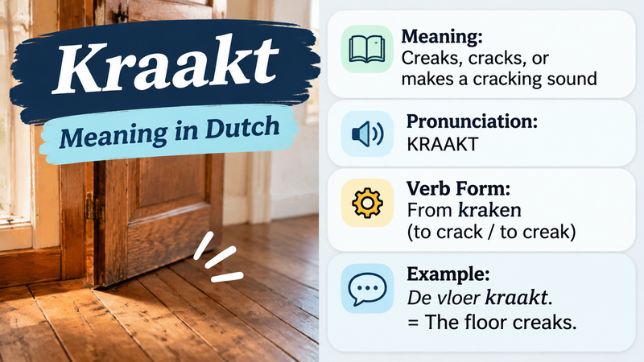
The word Kraakt is a Dutch verb form derived from the infinitive verb kraken. Depending on the context, it can mean creaks, cracks, crackles, or makes a cracking sound in English. It is commonly used to describe sounds made by objects such as wooden floors, doors, beds, and other structures. It can also describe the action of cracking something or making a cracking sound.
Understanding Kraakt requires looking at its grammatical form, pronunciation, and the situation in which it appears. Although it has several possible English translations, the surrounding words usually make its meaning clear.
What Does Kraakt Mean?
Kraakt is the second-person or third-person singular present-tense form of the Dutch verb kraken. Its exact English meaning depends on the subject and context.
Here are some common translations:
- Creaks: When a door, floor, or wooden structure makes a noise.
- Cracks: When something produces a cracking sound or breaks.
- Crackles: When something makes repeated sharp, small noises.
- Crunches: In certain situations involving pressure or breaking sounds.
For example:
- De vloer kra akt. — The floor creaks.
- Het bed kra akt. — The bed creaks.
- De deur kra akt. — The door creaks.
These examples demonstrate that Kraakt is not limited to one English translation. The correct interpretation depends on the complete sentence.
What Language Does Kraakt Come From?
Kraakt comes from Dutch, a West Germanic language primarily spoken in the Netherlands and Belgium, as well as in some other regions.
The original verb is kraken, which describes making a cracking or creaking sound and can have additional meanings depending on the situation.
Kraakt is a conjugated form rather than a separate dictionary verb. It follows the regular Dutch verb-conjugation pattern.
For example:
- Ik kraak — I crack.
- Jij kraa kt — You crack.
- Hij kraa kt — He cracks.
- De vloer kraa kt — The floor creaks.
The word’s grammatical form changes according to the subject of the sentence.
How Is Kra akt Pronounced?
Kraa kt is pronounced approximately as KRAA KT.
It contains a long Dutch ‘aa’ vowel sound followed by a final consonant combination.
A simple pronunciation guide is:
- K: A sound similar to the English letter K.
- RAAK: A long vowel sound.
- T: A clear final T sound.
The Dutch infinitive kraken is represented approximately as /ˈkraːkən/.
For accurate pronunciation, listening to a native Dutch speaker is recommended because Dutch vowel sounds are not always identical to English sounds.
Kraakt Grammar and Verb Forms
Kraakt belongs to the verb kraken. Learning its different forms helps Dutch learners understand how it works in everyday sentences.
Here is a simple comparison:
| Dutch Verb Form | English Meaning |
| Kraken | To crack / to creak |
| Kraak | I crack / I creak |
| Kraakt | You crack / He cracks |
| Kra akte | Cracked / Creaked |
| Kra akten | Cracked / Creaked (plural) |
| Krakend | Cracking / Creaking |
| Gekraakt | Cracked / Creaked |
The word Kra akt is used in the present tense with singular subjects such as jij, hij, zij, and het. It can also be used with the polite pronoun u.
The form changes when the subject changes, so it is important to understand the basic Dutch conjugation rules.
How Is Kraakt Used in Different Contexts?
Kr aakt can communicate different actions and sounds. Its meaning becomes clearer when it is used in a complete sentence.
1. Kra akt Meaning as Creaks
One of the most common meanings of Kra akt is creaks.
It describes the sound produced by wooden or mechanical objects when they move or carry weight.
Examples:
- De houten vloer kraakt. — The wooden floor creaks.
- De oude trap kr aakt. — The old staircase creaks.
- Mijn stoel kraa kt. — My chair creaks.
In these sentences, Kr aakt describes a sound rather than necessarily indicating that something is broken.
2. Kr aakt Meaning as Cracks
Kr aakt can also mean cracks, particularly when something breaks or produces a cracking sound.
For example:
Hij kraakt zijn gewrichten.
English translation: He cracks his joints.
Another example:
Het hout kraakt.
English translation: The wood cracks or creaks.
The appropriate English word depends on whether the sentence describes a breaking action or a noise.
3. Kraa kt Meaning as Crackles
In some situations, Kraak t can describe repeated sharp sounds.
For example, a structure or material may produce small cracking noises when pressure or movement affects it.
English translations such as crackles or crunches may be more natural in particular contexts.
The important point is to translate the complete sentence rather than automatically choosing one meaning for Kraa kt.
What Is the Difference Between Kra akt and Kraken?
Although Kra akt and Kraken come from the same Dutch verb, they have different grammatical functions.
Kraken is the infinitive form, while Kraak t is a conjugated present-tense form.
Consider these examples:
| Dutch | English |
| Ik hoor de vloer kraken. | I hear the floor creak. |
| De vloer kra akt. | The floor creaks. |
| Hij hoort het bed kraken. | He hears the bed creak. |
| Het bed kraakt. | The bed creaks. |
The infinitive kraken is used after certain verbs, while kraakt is used when the subject requires the singular present-tense conjugation.
What Is the Difference Between Kraakt and Kraakte?
The main difference is the tense.
- Kraakt: Present tense.
- Kraakte: Singular past tense.
For example:
Present tense:
De deur kraakt.
Meaning: The door creaks.
Past tense:
De deur kraa kte.
Meaning: The door creaked.
This small spelling difference changes the time of the action.
Why Do Dutch Speakers Say Kraak Jij Instead of Kraakt Jij?
Dutch has a special grammatical rule involving the informal pronouns jij and je.
In a normal statement, the verb takes the -t ending:
Jij kraa kt de noot.
Meaning: You crack the nut.
However, when the verb comes before jij or je in a question, the final -t is generally removed.
Kraak jij de noot?
Meaning: Are you cracking the nut?
Compare these examples:
- Jij kra akt de code. — You crack the code.
- Kraak jij de code? — Are you cracking the code?
- Kra akt hij de code? — Does he crack the code?
- Kra akt u de code? — Do you crack the code? (formal)
This rule is useful for anyone learning Dutch because it explains why the same verb can appear with or without its final -t.
Common Mistakes When Understanding Kraakt
Dutch learners sometimes misunderstand Kraakt because they focus on its spelling instead of its grammatical role.
Here are some mistakes to avoid:
- Treating Kraakt as an infinitive
Kraa kt is a conjugated verb form. Its infinitive is kraken.
- Assuming it always means cracks
When describing wooden floors, stairs, and doors, the more natural English translation is often creaks.
- Confusing present and past tense
Kra akt describes the present, while kr aakte describes the singular past.
- Using the wrong subject agreement
In standard Dutch, ik kraak is correct, not ik kra akt.
- Ignoring sentence context
A word can have multiple translations. Always consider the subject and the action before choosing an English equivalent.
Quick Reference: Kra akt Meaning
| Question | Answer |
| What language is Kraakt? | Dutch |
| What is its original verb? | Kraken |
| What type of word is it? | Conjugated verb |
| What tense is Kraakt? | Present tense |
| What does Kraakt mean? | Creaks or cracks |
| What is its past tense? | Kra akte |
| What is its past participle? | Gekra akt |
| How is it pronounced? | Approximately KRAA KT |
| Is Kraakt an English word? | It is a Dutch verb form |
Questions About Kra akt
1. What Does Kraakt Mean in English?
Kra akt is a Dutch verb form that commonly translates as creaks or cracks. Depending on the context, it can also mean crackles or produce a cracking sound.
2. Is Kra akt a Dutch Word?
Yes. Kra akt comes from the Dutch verb kraken. It is a present-tense conjugated form used with singular subjects.
3. What Is the Original Verb of Kra akt?
The original infinitive is kraken. It is the basic dictionary form from which other conjugations, including Kraa kt, are formed.
4. What Is the Difference Between Kraakt and Kraken?
Kraken is the infinitive form, meaning to crack or to creak. Kraa kt is a present-tense form used with singular subjects such as he, she, it, and formal you.
5. What Is the Past Tense of Kraa kt?
The singular past-tense form is kra akte. Its plural past-tense form is kra akten? No. The correct spelling is kra akten without a space: kra akten is not standard; the correct form is kra akten?
6. Can Kra akt Mean Creaks?
Yes. Kr aakt commonly means creaks when describing sounds made by wooden floors, doors, beds, and stairs.
Conclusion
Kraakt is a Dutch present-tense verb form derived from kraken. Its most common English meanings are creaks and cracks, although other translations may be suitable depending on the context.
Understanding its grammar, pronunciation, and relationship with other verb forms makes it easier to recognise and use correctly. Rather than memorising a single translation, learners should examine the complete sentence to understand what Kra akt communicates.