The question arrives every autumn with an invitation attached, and it deserves a complete answer rather than a partial one. What to wear to an oktoberfest depends on exactly three variables — which kind of Oktoberfest, who’s dressing, and what the weather’s doing — and once those are named, the answer writes itself for every case: Munich’s tents and the hometown festival, men and women, the September sun and the October chill. This guide is the complete answer, organized the way the question actually gets asked: the universal rule that covers every event first, the event-type matrix, the men’s and women’s standards side by side, the weather-and-practicality layer, and the mistakes list that covers everything the invitation didn’t mention.
The Universal Rule First
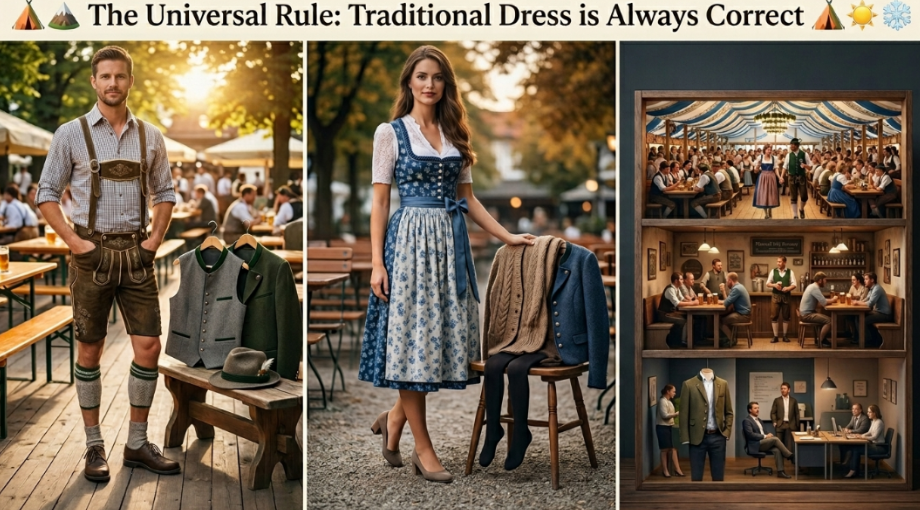
Across every Oktoberfest on earth, one rule answers the core question: traditional dress is the standard, and wearing it is always correct. There is no Oktoberfest — from the original tents to the smallest brewery lot — where the traditional outfit overshoots; there are many where street clothes undershoot. The corollary that removes the usual anxiety: visitors wearing Trachten aren’t appropriating anything — the festival tradition explicitly welcomes it, Munich included, where the tents expect exactly this and the locals read genuine attire as respect. And the quality clause the rule carries: the standard means real traditional wear — woven shirts, genuine leather, actual dirndls — with the vinyl costume tier reading as costume in every room that matters.
With the rule set, the variables sort the specifics.
The Event-Type Matrix
The invitation’s fine print writes the register. Munich and the major festivals: full traditional dress, quality tier — the rooms where the standard runs strongest and the costume tier reads harshest; the Classic builds below, worn complete. Hometown and brewery Oktoberfests: traditional dress remains the winning answer at any quality tier the budget allows — these are also the rooms where the relaxed builds (suspenders down, casual footwear) sit perfectly. Office and private Oktoberfest parties: read the host — full Trachten where the invitation leans in, the traditional-adjacent middle (checked shirt and quality basics for men, a dirndl-style dress for women) where it doesn’t. Beer gardens in season: the casual traditional register — the checked shirt doing the work even without the full system. The matrix’s summary: the deeper into tradition the event, the more complete the outfit — and at every level, what to wear oktoberfest resolves to some register of the same traditional answer.
The Men’s and Women’s Standards
Side by side, the two standards. Men: genuine lederhosen (short or knee-length, tan through brown), woven checked or white shirt tucked, H-bar suspenders over the shirt, wool knee socks, sturdy leather shoes — with vest, Janker and felt hat scaling the register upward; the casual configuration relaxes the accessories, never the foundation. Women: the dirndl as the classic — midi length as the modern standard, proper cropped blouse beneath, apron bowed on the code side (left single, right taken) — with flats or low block heels for the standing day; or women’s lederhosen as the fully traditional alternative that owns the dance floors — female-cut leather with cropped blouse, suspenders by choice, boots or clean sneakers. Both standards share the authenticity line: woven and genuine over printed and vinyl, fitted by measurement, worn by the conventions (tucked, tensioned, bowed correctly) that read as fluency everywhere.
Weather, Comfort and the Practical Layer
Autumn festivals span twenty degrees, and the outfit plans for it. The September events: breathable builds — the standard outfits as specified, sleeves rolled, the shorts-and-midi registers in their element. The October chill: the layering answers — the wool vest and Janker for men, the traditional cardigan or Trachten jacket and opaque tights for women, with the longer cuts (knee-length leather, longer dirndls) earning their register. The all-day practicalities that outrank fashion: broken-in footwear (the day is a standing marathon), a small crossbody or the trousers’ own pockets over anything that can’t dance, and the weather-proof note for outdoor festivals — wool’s whole tradition exists because it works damp. And the overnight rule for multi-day events: rotate shirts and blouses (the consumables), let the leather and dress air — the two-day wardrobe the tradition already engineered.
The Mistakes the Invitation Didn’t Mention
The short list that catches everything else. The costume-tier gamble: vinyl reads as vinyl at thirty paces and fails by hour two — the one purchase both genders regret in every room above a house party. The half-outfit: real lederhosen with an untucked tee, a dirndl without its blouse — the almost-right builds that read further from correct than honest casual would. The footwear optimism: new shoes or real heels at a ten-hour standing event — the mistake feet remember longest. The register mismatch: full formal Trachten at the brewery lot, street clothes at Munich — solved by the matrix above. And the timing failure that quietly causes half the rest: ordering late — festival season sells sizes through, and the complete answer requires the outfit actually arriving; the early-summer order is part of what to wear.
Frequently Asked Questions
What’s the one-sentence answer for any Oktoberfest?
Traditional dress at whatever quality tier you can manage — it’s correct at every event, and expected at the major ones.
Can visitors wear lederhosen and dirndls in Munich?
Yes, welcomed explicitly — the tents expect it, and genuine attire reads as respect; only the vinyl costume tier misfires.
What should men wear?
Genuine lederhosen, woven checked or white shirt tucked, suspenders, wool knee socks, leather shoes — relaxed or elevated by the event’s register.
What should women wear?
A midi dirndl with proper blouse and code-side bow, or women’s-cut lederhosen with a cropped blouse — flats or low heels for the standing day.
What about cold or rainy festival days?
Layer traditionally: vest and Janker for men, Trachten jacket and opaque tights for women, longer cuts for both — wool’s tradition exists for exactly this weather.
What’s the most common outfit mistake?
The vinyl costume tier and unbroken-in footwear — the two regrets every festival’s second hour collects.