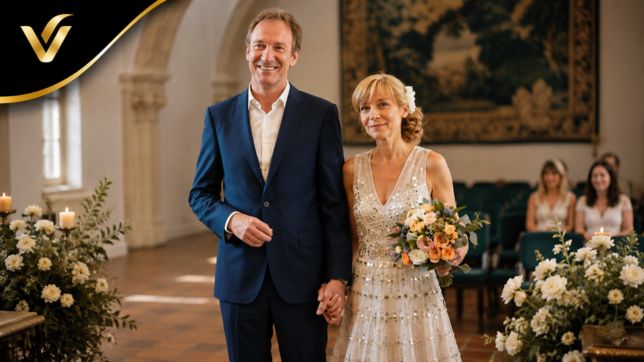
Some people become famous because they actively seek the spotlight. Others become known because their lives intersect with someone who has spent decades in public view. Hermine Poitou belongs more closely to the second category, although describing her simply through her marriage would overlook her own creative background and professional journey.
A French designer and artist, Poitou has worked across creative fields that include fine arts, graphic design, and film production. Before becoming more widely recognized as the wife of acclaimed English actor David Thewlis, she built experience behind the scenes in the film industry and developed her own identity as a visual creative.
Her story is particularly interesting because it combines two very different worlds: the highly visible world of international cinema and the quieter, more personal world of artistic work. While David Thewlis is recognized by audiences around the globe for his performances in films and television, his wife has largely maintained a private profile.
Yet the available details about her career, education, and creative interests reveal a woman whose life cannot be reduced to the phrase “celebrity spouse.” From her work in casting departments to her background in art and design, Poitou represents the many creative professionals whose contributions often happen away from cameras and red carpets.
This article explores her background, professional path, artistic interests, marriage, and the reasons her life continues to attract public curiosity.
Who Is Hermine Poitou?
Hermine Poitou is a French artist, designer, and former film production professional. She is widely known internationally because of her marriage to English actor David Thewlis, but her professional background extends beyond her relationship with the actor.
Her career has included work connected to the film industry, particularly in casting departments. She later focused more strongly on creative work involving art and freelance design. Her educational background in fine arts and graphic design also reflects a long-standing interest in visual expression.
Unlike many individuals connected to famous actors, Poitou does not appear to have pursued a major public celebrity identity. She has maintained a relatively low profile, with limited personal information regularly shared through mainstream media.
That privacy has naturally created curiosity. When someone appears alongside a globally recognized actor but remains largely outside the entertainment publicity machine, people often want to know more about the person behind the public appearances.
For Poitou, however, privacy seems to be an important part of how she lives. The information that is publicly available presents her as a creative professional rather than someone attempting to build fame from her husband’s reputation.
A French Background and Creative Identity
Poitou’s French identity has remained an important part of how she is described publicly. Although she has spent part of her life in England, her professional and personal background connects her to France and to European creative culture.
France has long been associated with influential traditions in art, design, cinema, and fashion. However, it would be simplistic to assume that every French artist or designer follows the same creative path. Poitou’s background appears to be shaped by her own experiences across education, film work, and independent artistic interests.
Her career suggests a willingness to move between disciplines. Film production, graphic design, and fine art require different skills, even though they all depend heavily on visual thinking and creativity.
This ability to work across creative environments can be especially valuable. A designer may think about communication, composition, typography, and audience perception. An artist may focus more deeply on expression and personal vision. Meanwhile, someone working in film production must understand collaboration, organization, and the practical demands of a large creative project.
These experiences can complement one another. Together, they create a broader understanding of how ideas move from imagination into finished work.
Education in Fine Arts and Graphic Design
One of the most important aspects of Poitou’s professional background is her education in fine arts and graphic design. Her studies included time at institutions such as the Camberwell School of Art & Design in London.
Camberwell has historically been associated with creative education and artistic development. Studying in an environment focused on art and design can expose students to different methods of visual communication, experimentation, criticism, and professional practice.
For an artist or designer, education is not simply about learning technical skills. It can also shape the way a person sees the world.
A graphic designer must consider how images and words communicate meaning. A fine artist may ask more open-ended questions about emotion, identity, materials, or experience. Both disciplines encourage observation, but they often use that observation for different purposes.
Poitou’s background in these areas helps explain why her career has moved across several creative spaces. The combination of artistic training and design education can provide flexibility, allowing a person to contribute to commercial projects while also maintaining an independent creative practice.
London may also have played an important role in broadening her professional opportunities. As one of Europe’s major centers for art, media, publishing, film, and design, the city brings together people from many countries and creative traditions.
Early Experience in the Film Industry
Before concentrating primarily on her work as an artist and freelance designer, Poitou gained experience in film production.
The film industry is often viewed through its most visible figures: actors, directors, and producers. In reality, every major production depends on a large network of professionals working behind the scenes.
Casting departments are an especially important part of this process. Finding the right performers can influence the entire tone of a film. Casting teams help identify talent, organize auditions, manage communication, and support the wider process of bringing characters from a script to the screen.
Working in this environment requires attention to detail and an understanding of people. It also requires the ability to operate within a collaborative system where many creative and practical decisions must come together.
Poitou’s experience in this field gave her direct exposure to professional filmmaking, a world that would later also become part of her personal life through her marriage to David Thewlis.
Work on Russian Dolls
Among her film credits, Poitou is associated with the French-British romantic comedy Russian Dolls, also known by its French title, Les poupées russes.
Released in 2005, the film continued the story begun in L’Auberge Espagnole. It was part of a European cinematic environment that brought together international characters and settings.
Poitou worked as a casting assistant, a role that is important even if it rarely attracts public attention. Casting assistants support the larger casting process and help manage many of the organizational details necessary to connect productions with performers.
The credit demonstrates that she was professionally involved in cinema rather than merely connected to it through a famous partner.
This distinction matters. People connected to celebrities are sometimes described only in relation to the more famous person. But Poitou’s film work existed as part of her own professional development.
Her experience also illustrates how much talent operates behind the camera. Audiences may remember actors’ names for decades, while the contributions of assistants, designers, coordinators, and other specialists remain largely invisible.
Yet filmmaking could not function without them.
Contribution to A Child’s Secret
Poitou is also credited for work connected with the 2006 drama A Child’s Secret (L’enfant du secret).
Like her involvement with Russian Dolls, this credit reflects her experience within professional casting and production environments.
The film industry often requires workers to adapt quickly from one project to another. Each production has its own creative vision, schedule, cast, and organizational structure. For someone working in casting, flexibility and communication are essential.
These early professional experiences likely provided valuable knowledge about the realities of filmmaking. They also placed Poitou in an industry that brings together people from different countries, languages, and artistic backgrounds.
For a person with interests in art and design, film can be an especially stimulating environment. Cinema combines visual composition, costume, performance, architecture, writing, music, and technology.
Even when a professional works in one specific department, they are still part of a much larger creative ecosystem.
From Film Professional to Artist and Designer
Over time, Poitou became more closely associated with her work as an artist and freelance designer.
This shift is interesting because creative careers are rarely straightforward. A person may begin in one discipline, develop new interests, and eventually create a professional identity that combines several different skills.
Freelance design can provide considerable independence. It allows creatives to work with different clients and projects while developing their own style and professional approach.
At the same time, freelance work requires more than artistic ability. Designers must often manage communication, deadlines, finances, and changing client expectations.
An artist faces a different but equally complex challenge: developing a personal creative voice while deciding how much of that work to share publicly.
Poitou appears to have chosen a path that gives her significant privacy. In an age when many creatives use social media to constantly promote their work and personal lives, maintaining a lower profile is a notable choice.
Her approach suggests that creative success does not always require becoming a public personality.
Marriage to David Thewlis
Hermine Poitou became internationally recognized after marrying David Thewlis on 6 August 2016.
Thewlis is one of Britain’s most respected actors, with a career spanning film, television, theatre, writing, and other creative pursuits. He has appeared in numerous acclaimed productions and is known to global audiences for playing Remus Lupin in the Harry Potter film series.
His long career has made him a familiar face at international premieres and entertainment events. As a result, public interest naturally extended to his personal life.
The marriage brought Poitou greater attention, particularly among fans searching for information about the actor’s wife.
However, their relationship has remained relatively private. They have not built their public image around constant interviews or highly publicized personal updates.
That decision is increasingly unusual in a media culture where celebrity relationships can become a form of entertainment themselves.
Instead, Poitou and Thewlis appear to balance public professional events with a largely private domestic life.
A Relationship Connected by Creativity
One of the most interesting aspects of their marriage is the creative connection between their professional worlds.
Thewlis is an actor and writer, while Poitou has a background in art, design, and film. Although their individual careers are different, both have spent significant time in creative industries.
This shared environment may provide an important point of understanding.
Creative professions can involve uncertainty, criticism, demanding schedules, and long periods of work that remain unseen by the public. Someone with experience in a creative field may better understand those pressures than someone completely outside that world.
Thewlis has occasionally shared positive comments and glimpses of his relationship with Poitou, including appreciation for her artistic abilities and sense of humor.
Such moments offer a small window into a relationship that is otherwise intentionally kept away from public scrutiny.
Their marriage also demonstrates that celebrity relationships do not all follow the same pattern. Some couples turn their private lives into a major part of their public brand. Others prefer to appear together only when professional circumstances naturally bring them into public view.
Poitou and Thewlis seem much closer to the second model.
Life in Sunningdale, England
Poitou and David Thewlis have been associated with life in Sunningdale, England.
The area provides a contrast to the constant activity of central London and the major entertainment capitals where international premieres and film events take place.
For someone seeking privacy, a quieter home environment can be especially valuable.
Privacy is not necessarily secrecy. There is an important difference between keeping personal boundaries and trying to hide completely from the public.
Poitou’s public appearances with her husband demonstrate that she does participate in important events. At the same time, she does not appear to use those occasions to aggressively promote a celebrity persona.
This balance may explain why information about her remains relatively limited. She is visible when necessary, but her life is not continuously placed on display.
Red Carpets and Major Film Events
Despite her preference for privacy, Poitou has appeared with Thewlis at important entertainment events and premieres.
These appearances often attract photographs and renewed public curiosity, particularly when the event involves a major global franchise.
The couple has appeared in connection with premieres associated with the Avatar film franchise, among other high-profile occasions.
Red carpet events can create an unusual situation for someone who is not primarily a celebrity performer. A designer or artist may attend because of their partner’s career while suddenly becoming the subject of fashion coverage, online discussion, and searches about their personal history.
Poitou has handled this visibility without dramatically changing her public identity.
She remains primarily associated with her own creative background while also being recognized as the wife of a famous actor.
That distinction is important because a person’s relationship status is only one part of a larger life story.
Why Public Interest in Hermine Poitou Continues
Interest in Hermine Poitou continues for several understandable reasons.
First, David Thewlis has a global fan base built over decades. Fans often want to know more about the people who are important in the lives of actors they admire.
Second, Poitou’s relatively private lifestyle creates a natural sense of mystery. When there is less information available, curiosity can increase.
Third, her own career is genuinely interesting. She has worked in film, studied art and design, and developed an identity as an artist and freelance designer.
This combination gives her a more complex story than the simple label of “David Thewlis’s wife.”
There is also a broader cultural reason. Modern audiences are increasingly interested in the creative people who work behind major industries.
The public now recognizes that actors and directors are only part of a much larger artistic ecosystem. Designers, casting professionals, editors, illustrators, photographers, writers, and many others contribute to the creative world.
Poitou’s career provides an example of this less visible side of the arts.
The Importance of Privacy in a Public World
Perhaps the most distinctive part of Poitou’s story is her ability to maintain privacy while being connected to international fame.
Today, visibility can feel almost unavoidable. Social media encourages constant sharing, and celebrity culture often treats private relationships as public content.
But there is still value in choosing boundaries.
Poitou demonstrates that a person can attend major public events without surrendering every part of their personal life. She can be married to a world-famous actor while still maintaining an independent professional identity.
Privacy may also protect creativity.
Artists often need time away from public opinion to experiment, reflect, and develop new ideas. Not every project needs to become immediate content for an online audience.
For creative professionals, this can be a powerful approach. The work itself can remain more important than constant personal exposure.
Hermine Poitou Beyond the Celebrity Label
It is easy for public attention to define people through the most famous individual connected to them.
But that approach can flatten a complex life.
Poitou has her own educational background, professional experience, and artistic interests. Her work in film casting and her studies in art and graphic design existed independently of the public attention created by her marriage.
Of course, her relationship with David Thewlis is an important part of her public story. It would be unrealistic to ignore it, because it is the primary reason many people first encounter her name.
Yet it should not be the final sentence of her biography.
Her career reflects a broader creative journey. She has moved between national cultures, educational environments, professional disciplines, and artistic roles.
That kind of journey is often more representative of modern creative careers than a single job title.
People today frequently develop several professional identities over time. A person can work in film, later become a designer, and continue to pursue independent artistic projects.
Poitou’s story fits that pattern.
Final Thoughts Hermine Poitou
Hermine Poitou remains a fascinating figure precisely because she occupies a space between public recognition and personal privacy.
She is internationally known as the wife of David Thewlis, but her own background tells a richer story. Her experience in film casting, education in fine arts and graphic design, and work as an artist and freelance designer reveal a professional identity built around creativity.
Her involvement with productions such as Russian Dolls and A Child’s Secret demonstrates her connection to filmmaking, while her later creative work reflects her broader artistic interests.
Her marriage in 2016 brought her greater global attention, yet she has not appeared to pursue fame for its own sake. Instead, she has maintained a relatively private life while occasionally accompanying her husband to major film premieres and public events.
Ultimately, her story offers an important reminder about how we view people connected to celebrities. Public curiosity may begin with a famous marriage, but an individual’s identity should not end there.
Poitou is a creative professional with experience across several artistic fields. She is an artist, a designer, a former film industry professional, and a person who has successfully maintained personal boundaries in an increasingly public world.
That combination of creativity, independence, and privacy is what makes her story compelling. While much of her life remains outside the spotlight by choice, the details that are publicly known reveal someone whose journey deserves recognition on its own terms.
Hermine Poitou FAQs
1. Who is Hermine Poitou?
Hermine Poitou is a French artist, designer, and former film production professional. She is widely known as the wife of acclaimed English actor David Thewlis.
2. When did Hermine Poitou marry David Thewlis?
Hermine Poitou married David Thewlis on 6 August 2016. The couple has maintained a relatively private relationship while occasionally appearing together at major film events.
3. What does Hermine Poitou do for a living?
Hermine Poitou has worked in several creative fields. She has experience in the film industry, including casting departments, and is also known for her work as an artist and freelance designer.
4. What films did Hermine Poitou work on?
She is credited as a casting assistant on films including Russian Dolls (Les poupées russes) from 2005 and A Child’s Secret (L’enfant du secret) from 2006.
5. Where did Hermine Poitou study?
Hermine Poitou has a background in fine arts and graphic design. Her education includes study at institutions such as the Camberwell School of Art & Design in London.
6. Where does Hermine Poitou live?
Hermine Poitou lives a relatively private life with her husband, David Thewlis, in Sunningdale, England.
7. Why is Hermine Poitou famous?
Hermine Poitou gained international attention primarily because of her marriage to David Thewlis. However, she also has her own professional background as an artist, designer, and former film industry professional.
8. Does Hermine Poitou appear at public events?
Yes. Although she prefers to keep her personal life private, Hermine Poitou has appeared with David Thewlis at selected high-profile events and film premieres, including events connected with the Avatar film franchise.
Hermine Poitou
Hermine Poitou
Hermine Poitou
Hermine Poitou
Hermine Poitou
Hermine Poitou
Hermine Poitou