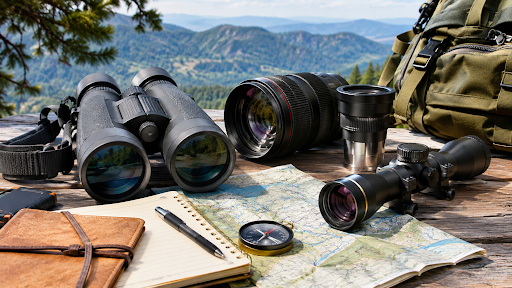
When people discuss precision optical equipment, attention often goes to new technology, attractive designs, and product specifications. Yet an equally important question receives less attention: what happens to an optical instrument after several years of ownership? Long-term value depends on more than its original condition. Product support, repair opportunities, responsible reuse, and end-of-life decisions all influence the complete ownership experience.
Modern optical manufacturers operate in an industry where equipment can contain valuable glass elements, metal components, and carefully assembled mechanical parts. Product categories such as Billings tactical scopes illustrate the specialized nature of these instruments. Looking beyond initial manufacturing helps explain why responsible product ownership and long-term support deserve greater attention throughout the optics industry.
Why Product Lifespan Deserves More Attention
The useful lifespan of a product describes how long it continues to serve its intended purpose.
For precision optical equipment, this period depends on several factors, including construction, environmental exposure, maintenance history, and the availability of appropriate professional support.
A product may remain physically intact for many years while still requiring occasional assessment or professional service.
Understanding this distinction is important because appearance alone does not establish the condition of internal components.
Long-term ownership also involves financial and environmental considerations.
Replacing equipment unnecessarily may create additional material demand, while keeping damaged equipment without proper evaluation can create other problems.
A responsible approach considers the actual condition of the instrument before deciding what should happen next.
Understanding the Complete Product Lifecycle
Every manufactured product passes through a series of stages, beginning with raw materials and continuing through production, distribution, ownership, and eventual disposal.
This sequence is commonly called the product lifecycle.
For optical instruments, the lifecycle includes the production of glass and metal components, assembly, packaging, transportation, and the period during which the equipment remains in service.
The final stage involves decisions about continued use, professional refurbishment, material recovery, or disposal.
Looking at the complete lifecycle helps businesses recognize that environmental responsibility extends beyond manufacturing facilities.
It also encourages consideration of how equipment can remain useful without compromising appropriate safety or quality expectations.
The Importance of Long-Term Product Documentation
Product documentation becomes especially valuable as equipment gets older.
An owner may no longer remember the original purchase details or understand which service arrangements apply to a particular model.
Clear documentation helps answer these questions.
Useful records may include model identification, original instructions, purchase information, warranty terms, and any previous service history.
Businesses also benefit from maintaining accurate documentation for products that remain in circulation.
Older equipment can create difficulties when model information disappears or relevant records are unavailable.
Providing accessible documentation is therefore one way manufacturers can support responsible product ownership.
The goal is to make reliable information available throughout a product’s useful life rather than only during its initial introduction.
When Professional Repair May Be Appropriate
Repair can sometimes extend the useful life of a manufactured product, but it is not always the appropriate solution.
The decision depends on the nature of the problem, the condition of the equipment, and the availability of suitable professional services.
Some issues may involve replaceable external parts, while others may affect sealed or precisely aligned internal components.
Optical equipment should not automatically be treated like an ordinary household object that can be opened and repaired without specialist knowledge.
Unauthorized work may damage delicate components or affect the condition of the instrument.
Owners should follow manufacturer guidance and contact qualified service providers when technical concerns arise.
Professional assessment can help determine whether further service is practical or whether replacement is more appropriate.
Why Repairability Is a Design Consideration
Repairability refers to how practical it is to restore a product when something goes wrong.
Different products offer different levels of repairability.
Some equipment is designed around components that can be serviced individually, while other products contain assemblies that are difficult to access without specialized facilities.
Manufacturers may need to balance repairability with other requirements, including environmental sealing, structural integrity, and production complexity.
For this reason, a design that is easier to disassemble is not automatically superior in every situation.
Meaningful repairability depends on whether appropriate servicing can be performed while preserving the required condition of the finished product.
Clear service policies help owners understand these limitations without making assumptions.
The Difference Between Repair and Refurbishment
Repair and refurbishment are related concepts, but they do not necessarily mean the same thing.
Repair generally addresses a specific fault or damaged component.
Refurbishment can involve a broader process of evaluating and restoring an existing product to an identified condition.
For specialized optical instruments, refurbishment may require professional inspection and testing.
A refurbished product should not automatically be described as equivalent to a new one.
Its condition depends on the work completed, the components involved, and the standards used during evaluation.
Clear descriptions are important when refurbished equipment is offered commercially.
Customers should be able to understand what has been examined, what work has been performed, and whether any service commitments apply.
How Product Collections Connect to Long-Term Ownership
Manufacturers organize optical equipment into product families to communicate differences between models.
This organization can also become useful during the later stages of a product’s life.
Identifying the correct model helps distinguish applicable documents and manufacturer guidance from information intended for unrelated products.
For example, the Billings tactical scopes collection provides a reference point for examining the company’s published models and product information.
A dedicated product category can help readers locate relevant descriptions, although it does not by itself establish whether a particular model is repairable or eligible for after-sales service.
Questions about service arrangements should always be confirmed directly with the relevant provider.
Accurate model identification is an important foundation for those conversations.
The Growing Interest in Reuse
Reuse involves allowing an existing product to serve a further useful purpose rather than immediately treating it as waste.
Across consumer industries, reuse can take different forms, including secondhand ownership, professional refurbishment, and authorized redistribution.
However, products should be suitable for continued service before being reused.
An item that looks undamaged may still have internal problems that are not obvious through a casual visual inspection.
This is particularly relevant to precision equipment containing sensitive optical or mechanical components.
Responsible reuse therefore depends on accurate descriptions and appropriate condition assessments.
It should never involve concealing defects or presenting an item as new when it has previously been used.
Why Optical Equipment Is Not Always Easy to Recycle
Recycling is an important part of material management, but not every manufactured product can be placed directly into ordinary household recycling.
Precision optical instruments may contain combinations of glass, metals, plastics, coatings, adhesives, and other materials.
These components may require different processing methods.
The presence of recyclable materials does not guarantee that a complete product can be accepted by a local recycling facility.
Recycling arrangements also differ between locations.
Before disposing of specialized equipment, owners should check the accepted materials and relevant local requirements.
Electronic optical devices may have additional disposal considerations that do not apply to purely mechanical instruments.
Understanding these differences helps prevent well-intentioned but inappropriate recycling decisions.
How Businesses Can Encourage Responsible Product Lifecycles
Manufacturers and distributors can influence product lifecycles through the information and support they provide.
Businesses do not need to make exaggerated environmental promises to communicate responsible practices.
Practical steps may include:
- Accessible documentation: Providing clear model information and relevant product instructions.
- Service transparency: Explaining available professional support and its limitations.
- Accurate condition descriptions: Distinguishing new, used, and refurbished products.
- Responsible disposal information: Directing customers toward appropriate local recycling guidance when available.
The suitability of these practices depends on the company’s products and operating arrangements.
What matters is communicating accurately rather than presenting general sustainability language without supporting information.
The Financial Side of Product Longevity
Long-term ownership can affect the overall cost of technical equipment.
The initial purchase price represents only one part of that cost.
Depending on the product, additional expenses may involve professional service, transportation, replacement components, or eventual disposal.
However, keeping an older product is not always cheaper than replacing it.
The cost of service, expected remaining life, and condition of the equipment all influence the decision.
Businesses and consumers benefit from comparing these factors realistically.
A useful ownership assessment considers both immediate expenses and the practical value of continuing to use an existing instrument.
This perspective avoids assuming that replacement or repair is always the better choice.
Environmental Responsibility Without Misleading Claims
Sustainability has become a familiar topic in manufacturing, but environmental claims should be specific and supported by evidence.
Describing a product as environmentally friendly simply because it contains metal or can last for several years may be misleading.
A meaningful environmental assessment can involve material extraction, production processes, transportation, product lifespan, and disposal.
These stages may have different environmental effects.
Reducing unnecessary waste and extending suitable product lifespans can support broader resource-management goals.
However, no single feature determines the complete environmental impact of a product.
Businesses should communicate measurable practices and acknowledge important limitations rather than relying on vague promotional statements.
The Future of Long-Term Optical Product Support
As industries develop more sophisticated manufacturing and information systems, long-term product support may become easier to organize.
Digital records can help businesses maintain model information, track product changes, and provide updated documentation.
Manufacturers may also explore ways to improve material efficiency and consider end-of-life requirements during product development.
The extent of these changes will depend on technical feasibility, costs, and industry requirements.
For optical equipment, professional service and responsible handling will remain important considerations.
The broader opportunity is to treat product ownership as a continuing relationship rather than an event that ends immediately after delivery.
Conclusion
The value of precision optical equipment extends beyond its first day of ownership. Documentation, professional service, responsible reuse, and appropriate end-of-life handling all contribute to the broader product lifecycle. By understanding these considerations, businesses and consumers can approach long-term ownership with greater awareness and make more informed decisions about equipment that has already been manufactured.
For readers interested in contemporary optical equipment and manufacturer-published product information, billingsoptics.com presents specialized rifle scope collections and technical descriptions. Such information provides a useful starting point for identifying products and understanding their published characteristics, while individual questions about repair, refurbishment, or service availability should be confirmed with the manufacturer.
Ultimately, responsible product ownership is about recognizing that every manufactured instrument has a lifecycle. Giving appropriate attention to its condition, available support, and eventual disposal can contribute to better resource management and more transparent business practices. As the optical industry continues to evolve, thinking beyond the initial purchase will remain a valuable part of understanding the complete product experience.