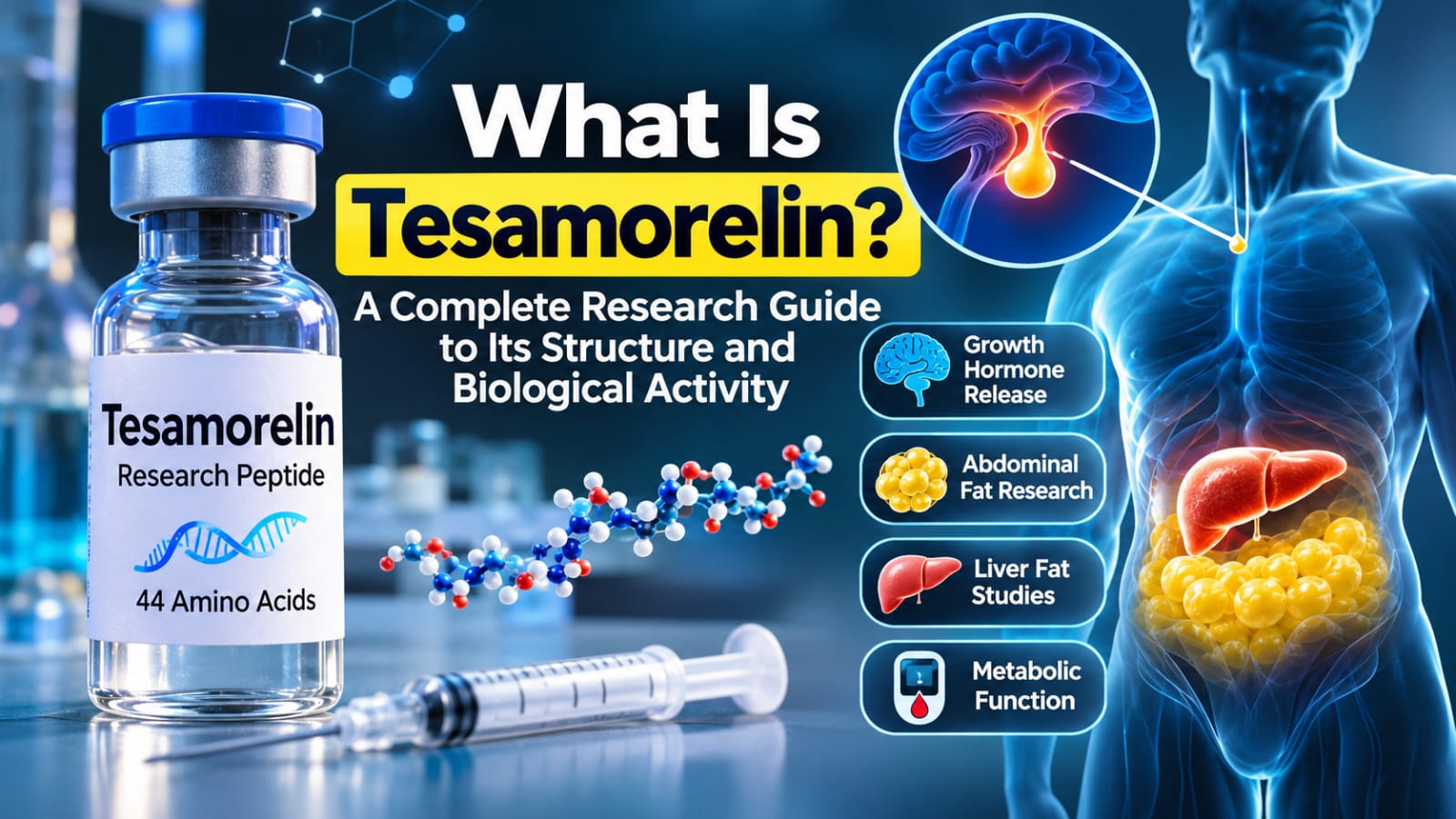
Acquaintance with synthetic growth hormone secretagogues involves studying the mechanisms of action of altered peptides and their interaction with certain hormone receptors. In terms of research concerning energy expenditure and pituitary function, one particular group of compounds is easily noticeable due to its unique structure and favorable bioavailability for the intended targets. The majority of scientists working on the topic of growth hormone-releasing hormone (GHRH) activity use artificially synthesized samples, which can be used to study cellular activity, binding efficacy, and subsequent events connected with the metabolic processes.
The term that has been used in scientific literature for the Tesamorelin peptide is Stable Artificial Peptide. This peptide is made up of 44 amino acids and functions similar to the naturally occurring GHRH peptide in the brain. The Tesamorelin has the ability to interact with the GHRH receptors which are located in the pituitary gland. Through this interaction, the Tesamorelin makes sure that there is a periodic secretion of growth hormones.
1. Molecular Structure and Chemical Profile
Human native growth hormone releasing hormone is made up of 44 amino acids. But in vivo, the degradation of this hormone is fast because of enzymes, mainly the enzyme dipeptidyl peptidase-4. To enhance the activity period of this hormone, an analogue was synthesized.
Key Structural Features:
- Sequence & Length: A chain made up of 44 parts (residues) has a change at the N end.
- Trans-3-Hexenoyl Modification: A trans-3-hexenoyl group is put at the N end. This keeps the peptide safe from being cut by DPP-4 enzymes.
This change in structure makes plasma more stable in people, rats, and dogs than native GHRH. It helps GHRH work at the receptor for a longer time. This does not change how well it binds to the GHRH receptor.
2. Mechanism of Action and Biological Activity
This molecule mainly works by sending signals in the front part of the pituitary gland.
| Step | Biological Event | Signaling Mechanism |
| 1. Receptor Binding | Binds selectively to the GHRH receptor on pituitary somatotropes. | High-affinity ligand-receptor coupling. |
| 2. Intracellular Cascade | Activates the adenylyl cyclase system. | Increases intracellular cyclic AMP (cAMP) levels. |
| 3. Hormone Secretion | Triggers exocytosis of stored growth hormone. | Promotes natural, pulsatile GH release into circulation. |
| 4. Downstream Signaling | Circulating GH travels to the liver. | Stimulates the production of Insulin-like Growth Factor 1 (IGF-1). |
3. Key Areas of Research and Scientific Evidence
People who study this peptide are interested in how it links to body health, belly fat, and fat that builds up in the liver.
- Increase in abdominal girth
Based on research evidence and laboratory testing, the function of receptors of GHRH signaling is targeted towards the visceral fat specifically. This is the fat in the inner abdomen, around the internal organs. In the cases when patients received the therapy or a placebo, the ones with changes in metabolism and abdominal fat have experienced significant reduction of the visceral fat. There were very few changes in the fat tissue found in the subcutis.
- Hepatic Transporter
Other than the fat in the abdomen, medical sources show that signaling pathway can influence the growth of hepatic fat. Drops of fat accumulation in the liver suggest the possibility of developing new therapies for nonalcoholic fatty liver disease and metabolic dysfunction.
- Glucose and Endocrine Function
One more important aspect in clinical studies of the drug is its effects on the metabolism of the patient. In case when the hGH is prescribed, temporary increases in fasting blood glucose or insulin sensitivity may happen. However, when stable analogues of GHRH are being used, they hardly influence the balance of blood glucose levels.
Conclusion
As research in hormone control and body health keeps changing, targeted GHRH analogs are important for studying how the body releases hormones. TheTesamorelin peptide has a special setup. It uses a basic 44-amino chain with N-end covering. This gives scientists a good model to look at belly fat, how fats are spread in the liver, and how the pituitary sends signals.
For more latest stories and updates, visit VA Magazine.