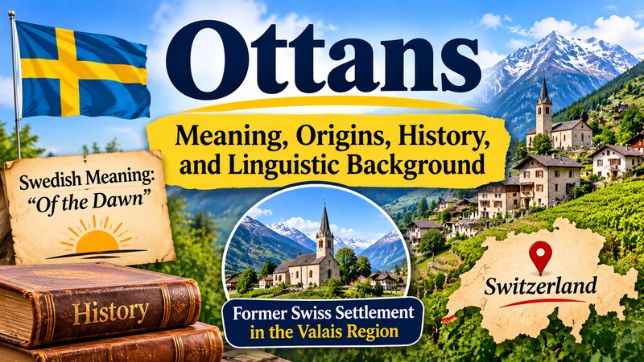
The word Ottans is an interesting term that attracts attention because of its different linguistic, historical, and geographical associations. Although it is not a widely recognized English vocabulary word, it appears in several contexts, including Swedish language references, historical European records, and modern online discussions.
Understanding Ottans requires looking beyond a single definition. In Swedish, the word is connected to the noun otta, which refers to the early morning hours before sunrise. In historical European documents, Ottans is also the name of a former settlement in the Valais region of Switzerland.
These different connections make Otta ns an interesting subject for people researching unusual words, European history, language development, and geographical names.
This article explores the meaning of Otta ns, its possible origins, historical background, linguistic connections, and the reasons people continue to search for the term.
What Is Ottans?
Ottans is a term with more than one possible interpretation depending on its context. It is not an established English word with one universally accepted definition.
One documented interpretation comes from Swedish grammar. The Swedish noun otta means dawn or the early morning period. Its definite form is ottan, while ottan s is the genitive form, commonly translated as “of the dawn” or “the dawn’s.”
Another important connection is historical geography. Ottans was the name of a settlement in the Valais region of Switzerland. Historical documents indicate that the settlement existed during the medieval period but eventually disappeared.
These two interpretations demonstrate why context matters when researching Ott ans.
The Meaning of Ottans in Swedish
One of the clearest linguistic explanations of Ottans comes from the Swedish language.
The Swedish word otta describes the earliest part of the day, particularly the hours before sunrise. It can also refer more generally to an early morning period.
The word has historical connections to Old Swedish and Old Norse vocabulary.
In Swedish grammar, nouns can change their forms depending on how they are used in a sentence. The form ot tans represents the possessive or genitive form of the definite noun ottan.
Its English equivalents include:
- Of the dawn
- The dawn’s
- Belonging to the early morning
This interpretation is particularly interesting for people studying Scandinavian languages and traditional European vocabulary.
Historical Origins of the Word Ottans
The linguistic background of Ott ans is connected to the history of the Swedish word otta.
The word developed from Old Swedish forms and is related to Old Norse ótta. Historically, these expressions described the period toward the end of the night and the beginning of daylight.
Over time, the word continued to appear in Scandinavian vocabulary, literature, and expressions describing early morning activities.
Its historical development demonstrates how languages preserve older expressions even as pronunciation, grammar, and everyday communication change.
The Swedish form ottans therefore offers a small example of how traditional vocabulary continues to exist within modern language structures.
Ottans as a Historical Place Name in Switzerland
Beyond its linguistic meaning, Ottans has an important geographical connection to Switzerland.
Historical records identify Ot tans as a former settlement in the Valais region, near the Martigny area.
The settlement is associated with the surrounding communities of Salvan and Vernayaz. Historical research has examined its location, boundaries, and relationship with other medieval settlements.
Ottans is particularly interesting because it eventually disappeared as a populated village, leaving historical references and geographical names that help researchers understand its former location.
Early Historical References
Historical documents provide evidence that Ottans existed more than a thousand years ago.
One important reference dates to 1011, when land at a location called Autannis near Octodurum was mentioned in a document associated with Saint-Maurice.
Later medieval records provide additional information about the settlement and its surrounding territory.
A document from 1192 also refers to the village of Ottans in connection with a land donation to the Abbey of Saint-Maurice.
These references demonstrate that Ottans was not simply a modern geographical label but a place with a documented medieval history.
Why Did the Settlement Disappear?
The historical settlement of Ottans eventually disappeared, and researchers have investigated its location using old documents, property boundaries, and geographical evidence.
The surrounding landscape includes areas affected by natural geological processes, including landslides and rockfalls.
Although these geographical conditions help explain the area’s historical development, it is important not to attribute the disappearance of the entire settlement to one specific event without sufficient historical evidence.
Today, the name Ottans survives primarily through historical documentation and local geographical references.
The Difference Between Ottans and Ottan
Ottans and Ottan may look similar, but they should not automatically be treated as the same word.
Ottans can refer to the Swedish genitive form of ottan or the historical Swiss place name.
Ottan is the base spelling of a separate name that also appears in modern discussions about sustainable materials and interior design.
For example, Ottan is associated with a company that develops materials using recovered organic ingredients and agricultural by-products.
These connections demonstrate why readers should examine the context before deciding what Ottans means.
A similar spelling does not necessarily indicate the same origin, meaning, or subject.
Linguistic Importance of Ottans
Ottans offers an interesting example of how grammar influences the appearance of words.
In Swedish, possessive relationships can be expressed by adding an -s ending to a noun. This grammatical feature is familiar to speakers of several Germanic languages.
For someone learning Swedish, understanding the relationship between otta, ottan, and ottans provides an opportunity to explore noun forms and possessive structures.
It also demonstrates how a word can have a meaning that is not immediately obvious to someone unfamiliar with the language.
Studying such expressions can improve vocabulary, reading comprehension, and understanding of Scandinavian linguistic traditions.
Cultural and Historical Significance
The significance of Ottans comes from its connection to both language and European history.
Its Swedish linguistic meaning reflects traditional ways of describing the transition between night and day. Early morning has historically been important for farming, religious activities, travel, and everyday work.
Meanwhile, the former Swiss settlement provides an example of how communities developed, changed, and sometimes disappeared throughout medieval European history.
Historical place names are valuable because they preserve information about settlements that may no longer exist in their original form.
Researchers can use these names alongside historical documents, maps, and archaeological evidence to reconstruct earlier patterns of human settlement.
Why Is Ottans Attracting Online Attention?
Several factors may explain why people search for Ottans.
1. Unusual Spelling
The word is relatively uncommon in everyday English, making it interesting to people who encounter it in articles, historical references, or online searches.
2. Scandinavian Language Connections
Its relationship with the Swedish word otta encourages interest among people studying Swedish grammar and vocabulary.
3. Historical European References
The former Swiss settlement gives Ottans an additional historical dimension that attracts readers interested in medieval geography.
4. Different Online Interpretations
Various websites discuss Ottans in different contexts, including language, history, and sustainable design. This can make it difficult for readers to identify the intended meaning.
5. Curiosity About Uncommon Words
People frequently search for unfamiliar expressions to understand their origins, translations, and cultural associations.
Together, these factors help explain the growing interest in Ottans as an informational search term.
How to Research the Meaning of Ottans
Researching an unfamiliar word requires attention to its original context.
For Ottans, readers can begin by consulting Swedish language dictionaries and historical references to understand its grammatical meaning.
People interested in the Swiss settlement can examine medieval documents, regional historical publications, and geographical research.
It is also useful to compare similar spellings carefully. Words that look alike may have completely different origins.
Using reliable historical and linguistic references makes it easier to distinguish established facts from unsupported online interpretations.
The Lasting Importance of Historical Words and Place Names
Words and geographical names preserve important information about the past.
Even when a settlement disappears or a traditional expression becomes less common, its name can survive in documents, dictionaries, and local references.
Ottans illustrates this idea particularly well. Its linguistic connection with early morning reflects Scandinavian vocabulary, while its historical geographical connection provides insight into medieval Switzerland.
Studying these connections allows readers to understand how language and geography contribute to cultural history.
Conclusion
Ottans is an interesting term with documented linguistic and historical connections. In Swedish, it is the genitive form of ottan, a word associated with dawn and the early morning hours. Historically, Ottans was also the name of a former settlement in the Valais region of Switzerland.
These interpretations demonstrate that a single spelling can have different meanings depending on its context.
Whether someone is interested in Scandinavian vocabulary, medieval European settlements, or unusual geographical names, Ottan s provides an opportunity to explore the relationship between language and history.
Ultimately, understanding Ottan s requires examining reliable references and recognizing the difference between its various documented uses.
FAQs)
1. What does Ottans mean?
Ottan s has different meanings depending on context. In Swedish grammar, it means “of the dawn” or “the dawn’s.” It is also the name of a former settlement in Switzerland.
2. Is Ottan s a Swedish word?
Yes. Otta ns is a grammatical form derived from the Swedish noun otta, meaning dawn or early morning.
3. What is the English translation of Ottan s?
In its Swedish grammatical context, Ottans can be translated as “of the dawn” or “the dawn’s.”
4. Where was the historical settlement of Ottans located?
The historical settlement of Ott ans was located in the Valais region of Switzerland, near the Martigny area.
5. How old is the name Ottans?
Historical records mention the place under the name Autannis in 1011. Later documents also refer to Ottans during the medieval period.
6. What is the origin of the Swedish word otta?
The Swedish word otta developed from Old Swedish and is related to Old Norse ótta. It traditionally refers to the early morning hours before sunrise.
7. Is Ottans the same as Ottan?
No, not necessarily. Ottans has documented Swedish grammatical and Swiss geographical meanings, while Ottan is also used as a separate modern name, including by a sustainable-materials company.
8. Why is Otta ns historically important?
Ottan s is historically interesting because medieval records preserve information about a former Swiss settlement that eventually disappeared.
9. Is Otta ns still a populated village?
The historical settlement of Otta ns is considered disappeared. Its name survives in historical and geographical references.
10. Why do people search for Ott ans?
People search for Otta ns to discover its meaning, Swedish linguistic background, historical Swiss connections, and possible interpretations in modern online discussions.