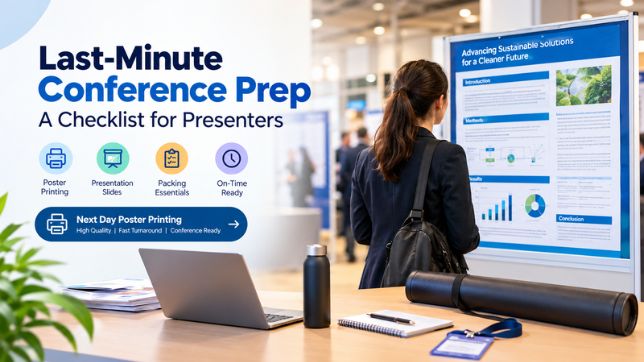
Preparing for a conference at the last minute can feel stressful, especially when you still need to print your research poster, check your slides, and organise your presentation materials. However, with a clear checklist, you can handle the most important tasks without rushing through every detail. A little planning can help you arrive prepared and present your work with confidence.
If your event is tomorrow, next day poster printing can help you get your presentation materials ready when time is limited. Whether you need a research poster, an academic display, or a simple presentation board, choosing the right printing service can save valuable time.
1. Finalise Your Presentation
Start by checking your presentation content. Make sure your main points are clear, your information is accurate, and your conclusion supports the purpose of your talk. Avoid making major changes unless you find an important mistake.
Use this quick checklist:
- Review your introduction and conclusion.
- Check spelling, grammar, and figures.
- Confirm your presentation follows the conference guidelines.
- Practise speaking within the allotted time.
- Save a backup copy of your slides.
A short practice session can help you spot missing information and feel more comfortable when presenting to an audience.
2. Arrange Next Day Poster Printing
If you are presenting academic research, your poster is one of the most important items to prepare. It should explain your work clearly and allow visitors to understand the main findings without reading long blocks of text.
When time is limited, look for a printing provider that offers next day poster printing and can confirm the required size, paper type, and collection or delivery time. Do not assume every service can meet your deadline, particularly during busy conference periods.
Before placing your order, check the following:
- Confirm the final poster dimensions.
- Export your design as a print-ready PDF.
- Check image quality and font readability.
- Review charts, references, and logos.
- Confirm the final price and completion time.
Always ask whether the printer needs extra time for finishing or delivery. Ordering as early as possible gives you more room to deal with unexpected delays.
3. Choose the Right Poster Size
The correct poster size depends on your conference requirements and the space available for displaying your work. Some events require large-format research posters, while others allow smaller presentation boards.
Cheap A3 posters can be a practical option for smaller displays, handouts, draft reviews, or situations where a full-size poster is not required. However, A3 paper may be too small for a standard academic poster session, so check the event instructions before ordering.
Consider these common uses:
- A0 or A1 posters: Suitable for many research and academic displays, depending on conference rules.
- A2 posters: Useful for smaller displays or compact research summaries.
- Cheap A3 posters: Ideal for handouts, supporting materials, and smaller presentation spaces.
Choose a size that makes your content easy to read from a comfortable distance. A lower printing cost is helpful, but the poster must still meet the organiser’s requirements.
4. Check Your Poster Design
A good research poster presents information in a clear order. Visitors should quickly understand your research question, methods, findings, and conclusion.
Keep your layout simple and avoid filling every available space with text. Use headings to separate sections and include charts or images where they explain your findings better than paragraphs.
Before sending the file to print, check:
- The title is easy to read.
- Body text is large enough for the intended viewing distance.
- Colours provide enough contrast.
- Images and graphs are clear.
- Important findings stand out.
- No text or graphics are cut off at the edges.
Ask a colleague to review the final design if possible. A fresh pair of eyes can catch errors you might overlook after spending hours on the same document.
5. Pack Your Conference Essentials
Once your presentation and poster are ready, gather everything you need for the event. Packing the night before reduces the chance of forgetting something important.
Use this checklist:
- Printed poster and protective tube, if needed
- Laptop and charger
- USB drive with backup files
- Presentation slides and research notes
- Business cards or contact details
- Notebook and pen
- Conference registration confirmation
- Transport details and venue information
If you are travelling with a large poster, check the transport arrangements and venue rules. Keep your printed materials protected from rain, creases, and accidental damage.
6. Confirm Printing and Collection Times
A last-minute order is only useful if the finished poster is available when you need it. Contact the printing provider before submitting your payment or final file to confirm the deadline.
Ask whether the quoted turnaround includes printing, finishing, and delivery. If collection is required, check the opening hours and allow enough time to reach the shop.
When comparing next day poster printing services, consider more than price alone. Reliable communication, clear file requirements, print quality, and a confirmed completion time can make a major difference when your conference is approaching.
Keep a digital copy of your final artwork and the order confirmation. These details can help resolve problems quickly if a file needs to be resent or a collection time changes.
7. Prepare for Questions
Conference presentations often lead to useful conversations with researchers, students, and industry professionals. Prepare a short explanation of your work that you can deliver in about one minute.
Think about the questions visitors might ask:
- What problem does your research explore?
- Why did you choose this method?
- What are your most important findings?
- What are the limitations of your work?
- What could happen next?
You do not need to memorise every answer. Understanding your research well enough to explain it in simple language is more useful than rehearsing every sentence.
8. Review Everything the Night Before
Set aside a few minutes for a final review before going to bed. Check your travel plans, presentation files, poster, and conference schedule.
If you have ordered cheap A3 posters or other printed materials, count the copies and make sure they are in good condition. For larger research posters, confirm that the dimensions match the event requirements and that you know how to transport them safely.
Once everything is packed, get enough rest. Being alert and prepared will help you communicate your work more effectively than staying awake all night making unnecessary changes.
Conclusion
Preparing for a conference at the last minute does not have to become a major problem. By checking your presentation, reviewing your poster design, packing essential items, and confirming your printing arrangements, you can focus on sharing your work rather than worrying about missing details.
Next day poster printing is a useful option when a deadline is close, provided the printer confirms availability and turnaround time. Choose the right poster size, review your final file carefully, and keep your conference requirements in mind. With a practical checklist and a little organisation, you can arrive ready to present your research with confidence.
Tighten the article to reduce repetitionAdd a stronger printing-service call to action
You’re using the free version of ChatGPT. Upgrade for advanced models, better memory, and higher-quality image creation.
Upgrade to Plus