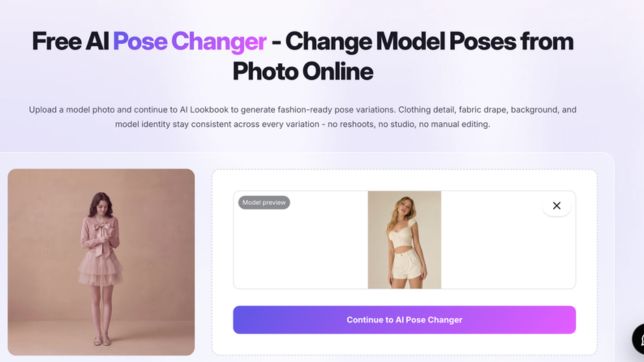
Fashion photography has always depended on careful planning. Models, photographers, lighting teams, locations, styling, and post-production all have to work together to create a finished image. Even a small change to a model’s pose can sometimes require a completely new photograph.
Artificial intelligence is beginning to change that process.
AI image editing tools can now modify photographs in ways that would previously have required extensive manual retouching or an additional photoshoot. One of the more interesting developments is the rise of AI pose changers, which allow creators to experiment with different model positions while working from an existing image.
For fashion brands, photographers, designers, and digital creators, this technology can provide a faster way to explore visual ideas and produce more variations from existing content.
What Is an AI Pose Changer?
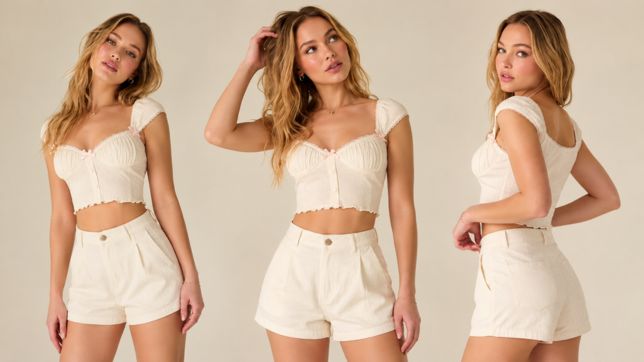
An AI pose changer is an image-editing technology that uses artificial intelligence to alter the pose or body position of a person in an existing photograph.
Traditional photo editing can adjust colors, remove objects, change backgrounds, or improve lighting. Changing the position of a person’s arms, legs, shoulders, or body is considerably more complicated because the edited image needs to remain visually consistent.
AI models can analyze the structure of a person within an image and generate a new version based on a requested pose. Depending on the tool, users may be able to create standing, sitting, walking, leaning, or other poses without photographing the same model again.
The result is not simply a copy-and-paste operation. The AI has to generate missing visual information while attempting to preserve important characteristics such as the person’s appearance, clothing, proportions, and the overall composition.
This makes pose changing particularly interesting for fashion photography.
Why Model Poses Matter in Fashion Photography
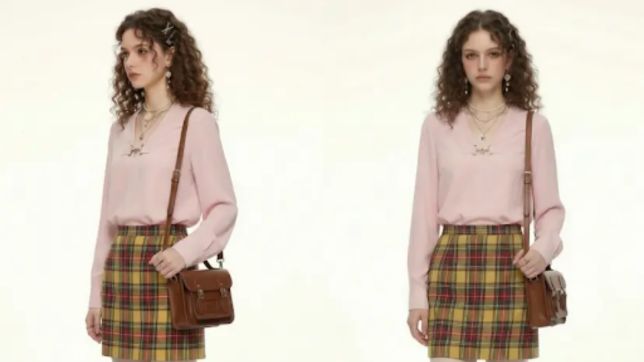
A model’s pose can completely change how an outfit looks.
A simple standing pose may show the overall silhouette of a garment. A walking pose can demonstrate how fabric moves. A seated pose can create a more relaxed editorial feeling, while a side-facing or leaning pose can emphasize particular details of an outfit.
Traditionally, photographers would capture dozens or even hundreds of poses during a shoot.
That process provides flexibility, but it also requires time and resources. Every additional pose has to be photographed, reviewed, and potentially edited.
AI pose technology introduces another possibility.
Instead of treating every photograph as a final asset, creators can use an existing image as a starting point and explore alternative poses digitally.
This can be especially useful when a brand already has high-quality model photography but needs additional variations for websites, advertisements, social media, or other digital channels.
From One Image to Multiple Creative Directions
One of the biggest advantages of AI image editing is the ability to experiment.
Imagine a fashion brand has a strong photograph of a model wearing a new jacket. The original image shows the model standing naturally, but the marketing team also wants an image where the model is sitting, another where the model is walking, and another where the model is leaning against a wall.
Normally, these variations would require additional photographs.
With an AI pose changer, creators can instead start with the existing image and generate alternative compositions.
Tools such as Fashion Diffusion AI are designed around this broader idea of AI-assisted fashion image creation. A creator can use AI-powered editing features to Change Model Poses and explore different visual possibilities without rebuilding the entire photoshoot from scratch.
This does not mean that traditional photography becomes unnecessary. Instead, AI can become another layer in the creative workflow.
How AI Pose Changing Works
Although the technology behind different platforms varies, the basic process involves several stages.
First, the AI needs to understand the subject in the photograph. It analyzes elements such as the person’s body position, clothing, facial features, and surrounding environment.
The system then interprets the desired pose. This might come from a reference image, a predefined pose, or another form of user input.
The difficult part comes next.
The AI needs to generate a new image while maintaining visual consistency. If an arm moves, for example, the system needs to reconstruct the sleeve, skin, shadows, and surrounding background. If the body rotates, the clothing may need to be regenerated from a different angle.
This is why modern AI image editing goes beyond simple filters.
The system is effectively generating parts of the photograph that were not present in the original image.
Fashion E-Commerce Is a Natural Use Case
AI pose changers can also be useful for e-commerce.
Online fashion stores need large quantities of visual content. A single product may need photographs for product pages, category pages, advertisements, social media campaigns, and promotional materials.
Different platforms also have different visual requirements.
A full-body standing image may work well for a product listing, while a more dynamic pose may be better suited to a social media advertisement.
Creating all of these variations through traditional photography can become expensive and time-consuming.
AI-generated pose variations offer another approach.
A brand can potentially start with a smaller collection of high-quality photographs and use AI editing to create additional visual variations. This can help teams test different compositions and determine which types of imagery work best for particular campaigns.
The technology may be especially useful for smaller fashion businesses that do not have access to large photography budgets.
AI Pose Changers and Social Media Content
Social media has created another demand for visual variation.
Fashion brands are expected to publish content regularly, but repeatedly showing the same photograph can make a campaign feel repetitive.
Changing a model’s pose can make existing imagery feel different without completely changing the outfit or concept.
For example, the same fashion look could be presented through a confident standing pose, a casual seated pose, or a more dynamic walking composition.
Combined with changes to backgrounds, lighting, styling, and image formats, AI editing can give creators more ways to repurpose existing visual assets.
This does not eliminate the importance of creative direction. In fact, it makes creative decisions more important.
The technology can generate possibilities, but people still need to decide which images communicate the right message.
The Benefits for Photographers and Designers
AI pose changing is not only useful for fashion brands.
Photographers can use it to explore alternative compositions after a shoot. Designers can visualize garments in different positions. Marketing teams can test campaign concepts before committing to another production.
It can also reduce some of the limitations associated with location-based photography.
If a team already has a suitable model photograph, generating additional variations may require less time than organizing another shoot with the same lighting, styling, and environment.
For independent designers and creators, this flexibility can be particularly valuable.
Instead of needing a large production team for every visual experiment, creators can use AI tools during the early stages of developing a campaign.
What AI Still Cannot Replace
Despite the rapid development of AI image technology, there are still important limitations.
AI-generated images can sometimes contain visual inconsistencies. Hands, clothing details, accessories, body proportions, and complex backgrounds may not always be reproduced perfectly.
This means human review remains important.
A generated pose might look impressive at first glance but contain a small problem that becomes obvious when the image is used commercially. Fashion brands therefore need to check details carefully before publishing AI-generated content.
There is also a creative consideration.
Photography is not simply about putting a person into a particular position. Lighting, emotion, styling, composition, movement, and the relationship between the model and the camera all contribute to the final image.
AI can help modify these elements, but creative direction still determines whether the final image works.
The Future of AI Fashion Photography
AI pose changers are part of a much larger shift in digital photography.
As image-generation and image-editing models become more sophisticated, the boundary between photography and digital creation is becoming less rigid. A fashion image can increasingly combine a real photograph with AI-generated elements, alternative poses, backgrounds, styling, and environments.
This could change how fashion teams approach production.
Instead of thinking about a photoshoot as the creation of a fixed collection of images, teams may increasingly view each photograph as a flexible digital asset that can be adapted for different purposes.
That does not necessarily mean replacing photographers or models.
Instead, AI can provide another set of creative tools that allow existing work to go further.